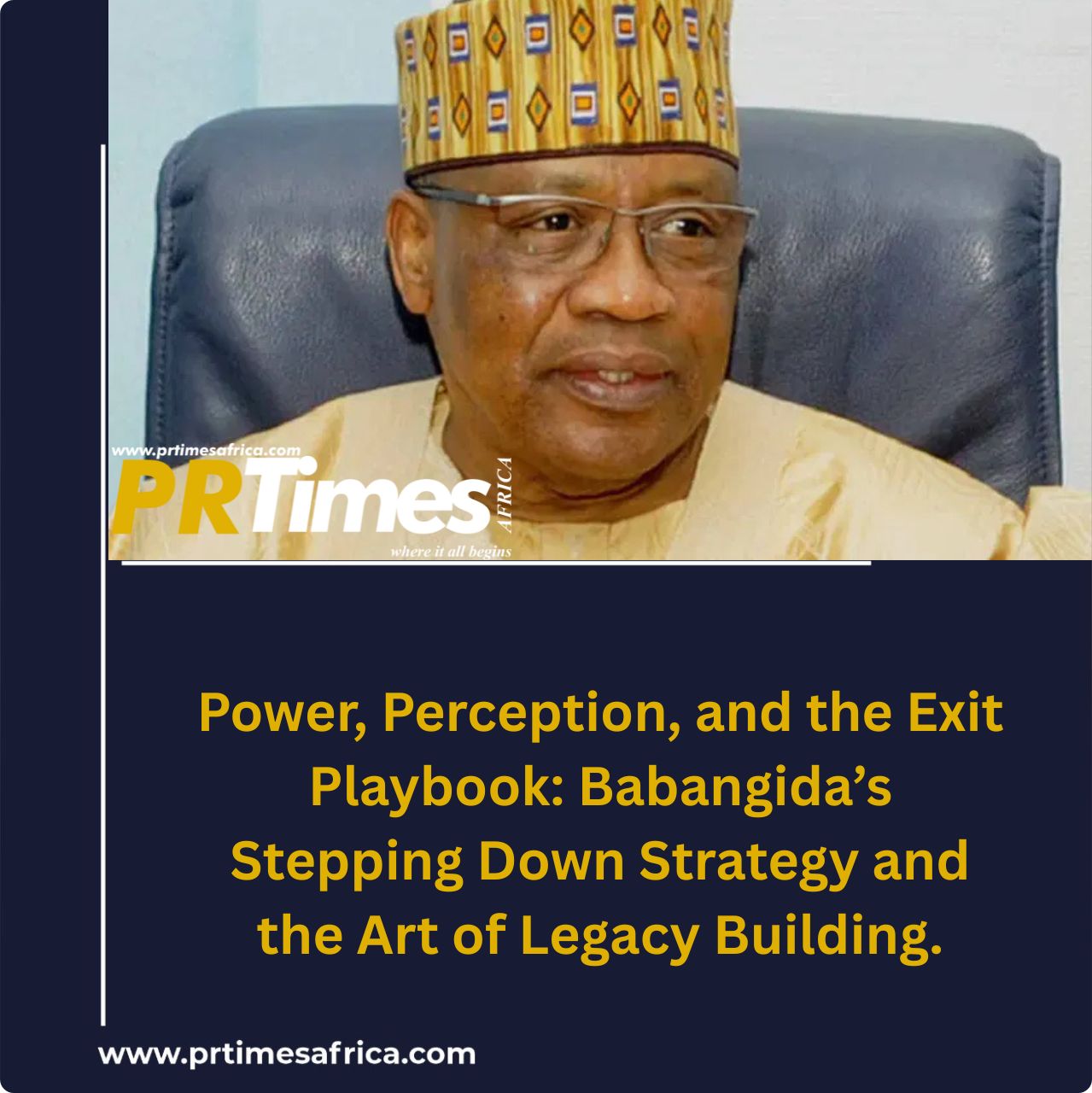
Power, Perception, and the Exit Playbook: Babangida’s Stepping Down Strategy and the Art of Legacy Building.
By Musa Sunusi Ahmad:
In the world of power, few acts are as scrutinized as the exit. For leaders, especially military rulers, the way they leave the stage often defines how history remembers them. One such case is that of General Ibrahim Badamasi Babangida (IBB), Nigeria’s military head of state from 1985 to 1993. While his administration was marked by complexity, contradictions, and control, his decision to “step aside” in 1993 was a calculated act of public relations choreography. It serves today as a master class in reputation strategy, crisis communication, and legacy management, whether one agrees with the outcome or not.
The Kingmaker in Uniform
IBB ascended to power through a palace coup in 1985, positioning himself as a “benevolent dictator” with a flair for statesmanship. His regime introduced bold economic reforms such as the Structural Adjustment Programme (SAP) and championed a transition to democratic rule, at least on the surface.
However, the road to democracy was riddled with controlled narratives, manipulated processes, and a constant recalibration of timelines. His political engineering birthed the infamous two-party system, National Republican Convention (NRC) and Social Democratic Party (SDP), and even designed a new political culture that blurred the lines between military command and civilian consensus.
The Annulment That Changed Everything
On June 12, 1993, Nigerians went to the polls in what was widely considered the freest and fairest election in the nation’s history. Businessman Moshood Kashimawo Abiola emerged the apparent winner against Bashir Usman Tofa. But in a stunning turn, Babangida annulled the election, citing security threats and legal irregularities. This decision plunged the nation into political crisis and shattered public trust.
It was at this critical juncture that Babangida executed what may be his most significant strategic maneuver: his stepping down.
“Stepping Aside” – A Crisis Communication Masterstroke
Rather than “resign,” Babangida announced on August 26, 1993, that he was “stepping aside.” The phrase, carefully chosen, was more than semantics. It was a public relations strategy designed to:
- Retain symbolic control: “Stepping aside” implied temporariness. He did not abdicate; he deferred.
- Avoid full accountability: By not fully owning the political failure, he sidestepped total blame for the annulment.
- Diffuse tension: The ambiguity of his departure created a psychological buffer in a volatile national climate.
To cushion the transition, Babangida installed an Interim National Government (ING) led by Chief Ernest Shonekan, an unelected technocrat whose appointment allowed Babangida to retreat from the scene while maintaining behind-the-curtain influence.
Legacy Building Through Narrative Control
Babangida’s departure wasn’t a retreat; it was a strategic repositioning. In communications terms, he was attempting to own the narrative while limiting reputational damage.
Key elements of this legacy-building strategy included:
- Soft power image crafting: Babangida presented himself as a reluctant authoritarian, forced by circumstances to act against his own democratic ambitions.
- Media management: State-controlled media were used to frame his exit as an act of sacrifice, positioning him as a patriot preserving national unity.
- Institutional memory manipulation: By engineering a political process and then walking away, he left a void that made his own era seem more “organized” in retrospect, especially after the chaos that followed.
The Long Game: Babangida’s Post-Exit Influence
Even after stepping aside, IBB remained a key power broker behind the scenes. From political endorsements to advisory roles, he wielded influence without office, a classic hallmark of strategic legacy management.
Despite the controversies, many aspects of modern Nigerian political architecture trace their roots to Babangida’s era. His communication strategy helped ensure that even critics referred to him with an air of intellectual respect, if not admiration.
Lessons for PR and Communications Professionals
- Control the Language, Control the Narrative: “Stepping aside” is a textbook example of how language can shape perception.
- Crisis Exit Can Be a Legacy Entry: How a leader exits a crisis can plant the seeds of legacy, even amid public outrage.
- Reputation is an Ongoing Project: Babangida didn’t stop communicating when he left office. He remained engaged in political discourse, shaping how history viewed him.
- Ambiguity Can Be Strategic: Sometimes, not saying everything, and not leaving entirely, can be a powerful move.
A Legacy Both Managed and Contested
Ibrahim Babangida’s exit from power may not have followed the classic democratic script, but in terms of strategic communication and legacy building, it remains a case study worth analyzing. His ability to pivot from authoritarian ruler to elder statesman, despite unresolved controversies, shows the enduring power of narrative strategy in leadership transitions.
In the end, history may judge his actions. But communications professionals must study his strategy.