Day: November 28, 2025

  • ECOWAS expels Guinea-Bissau after army general seizes power

    ECOWAS expels Guinea-Bissau after army general seizes power

    ECOWAS expels Guinea-Bissau after army general seizes power

    By: Keziah Biya

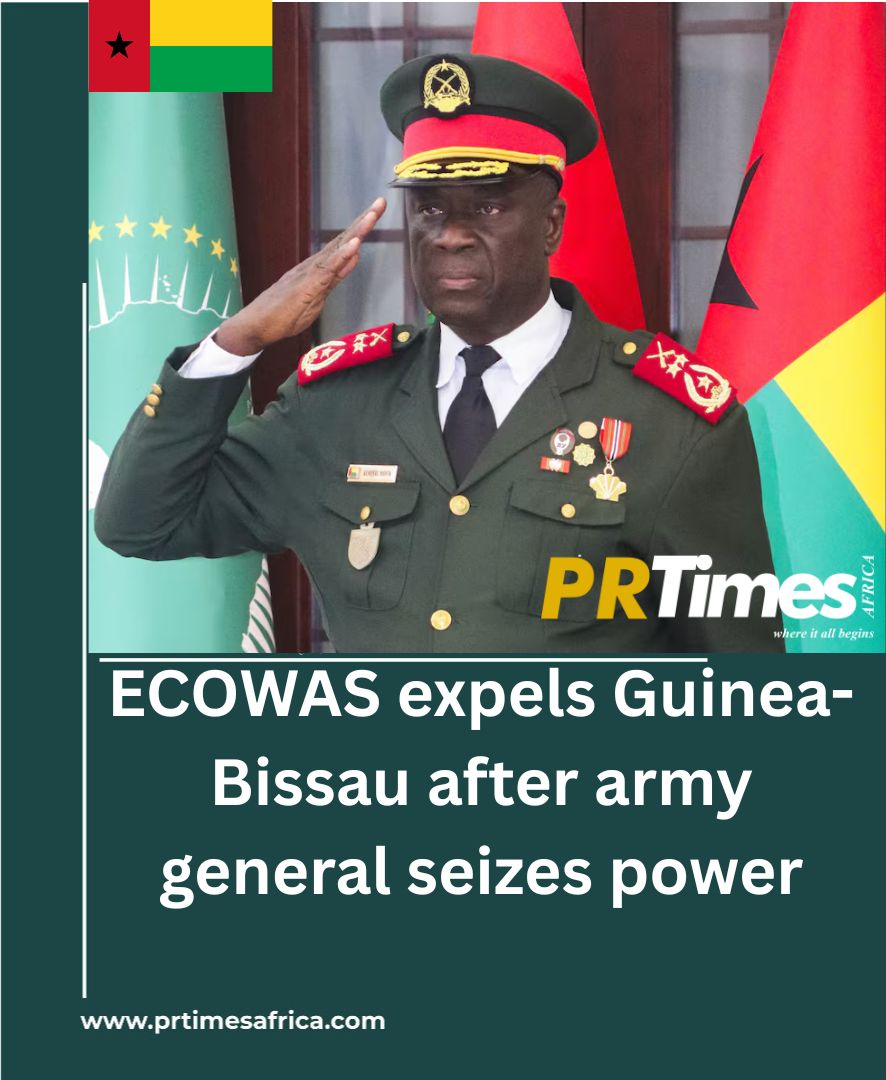
    On 26 November 2025, army officers in Guinea-Bissau declared they had seized power — just before provisional results from a hotly contested presidential election were to be announced.

    The soldiers announced the suspension of the electoral process, closure of borders, enforcement of a curfew, and formation of a junta they call the “High Military Command for the Restoration of National Security and Public Order.”
    The next day (27 November), Horta N’Tam (also spelled Horta Inta-A or Horta Nta Na Man in some reports) was sworn in as transitional president and head of the High Military Command, for a one-year transition.
    Meanwhile, the then-president, Umaro Sissoco Embaló, along with other officials including election and ministerial figures, were reportedly arrested by the military.
     How ECOWAS Responded
    ECOWAS held an emergency virtual session of its Mediation and Security Council (MSC) on 27–28 November 2025, chaired by the President of Sierra Leone (as bloc chair).
    The bloc strongly condemned the coup as an “illegal abortion of the democratic process” and called for “unconditional restoration of constitutional order.”
    Consequently, ECOWAS suspended Guinea-Bissau from all its decision-making bodies and regional activities until a legitimate constitutional order is restored.
    The bloc also demanded the immediate release of all detained political figures — including the former president, electoral officials, and other key actors.
    Additionally, ECOWAS said it reserves the right to use “all available options” under its protocols — including potential sanctions — if the junta does not comply.
    A high-level mediation team — including leaders from Togo, Cabo Verde, Senegal — was assembled to engage with the coup leaders.
     Why This Matters Regionally
    The coup interrupts a democratic electoral process; the provisional results of the November election (which might have decided a new president) were never announced.
    Guinea-Bissau now joins a growing list of West African countries where recent years have seen military takeovers — undermining regional democratic stability. Observers worry about contagion effects in the region.
    The international community (including the African Union) also condemned the takeover.
    What’s Next / What to Watch
    Whether the junta complies with ECOWAS demands: release political detainees, restore the electoral process, and return to constitutional order.
    The work of the ECOWAS mediation mission in Guinea-Bissau — whether it can persuade the military leadership to step back or negotiate transition terms.
    International reaction beyond ECOWAS — sanctions, diplomatic pressure, humanitarian implications, foreign investment.
    How this event affects regional stability and democracy in West Africa, given rising trends of coups in countries in the region.
  • Africa as a major mineral powerhouse

    Africa as a major mineral powerhouse

    Africa as a major mineral powerhouse

    By: Keziah Biya

    Africa remains one of the world’s richest regions when it comes to minerals and natural resources. The continent holds very large shares of global reserves for many critical and strategic commodities, including platinum group metals (PGMs), chromium, manganese, cobalt, diamonds, bauxite, and many others.

    According to recent data, Africa produces a large fraction of the world’s supply of certain minerals and metals: e.g. a dominant share of global platinum, manganese, chromium, and substantial shares of cobalt, diamonds, bauxite, gold, copper, lithium, uranium and graphite among others.

    Yet, despite this wealth, the continent faces challenges: many resources are exported as raw materials, rather than processed locally. Infrastructure gaps, policy uncertainty, and high operational costs continue to hamper transformation of mineral wealth into broader economic development.


     The “Big Five” mining countries: South Africa, Nigeria, Algeria, Angola, Libya

    These five countries are often identified as the top contributors to Africa’s mineral wealth,  together accounting for over two-thirds of the continent’s mineral output/value.

    Here’s a breakdown per country:

    South Africa

    Leads the continent in mineral wealth: estimates put its annual mineral-resource revenue (all minerals combined) at around US$ 125 billion per year.

    Produces a wide range of minerals: gold, platinum-group metals, diamonds, coal, iron ore, chromium among others.

    Globally, South Africa remains a major player: leading producer of platinum, manganese, chromium; among the top producers of coal, iron ore, titanium, zirconium, and more.


    Nigeria

    Estimated to generate around US$ 52–53 billion per year from minerals/oil.

    Nigeria’s mineral wealth is not limited to its famous oil: the country also has significant deposits of gold, iron ore, columbite, and other minerals.

    However, as in many African mining nations, the sector is “underdeveloped,” meaning many mineral deposits remain under-exploited.

    Algeria

    Generates around US$ 38–39 billion per year in mineral/hydrocarbon revenue (the exact mix is heavily skewed toward hydrocarbons).

    Though mostly known for oil and natural gas, Algeria has been flagged as having “potential” for further mineral development beyond hydrocarbons, especially if non-oil mineral deposits are more systematically developed.


    Angola

    Annual mineral/oil revenues estimated at around US$ 32 billion.

    Angola’s resource base includes oil, diamonds, gold, and other minerals.

    As with many other African nations, there is likely room for growth, particularly if infrastructure, regulation, and mining investments are improved.


    Libya

    Estimated mineral (and hydrocarbon) wealth: about US$ 27 billion per year.

    Libya’s strengths are largely in oil, but it also possesses industrial minerals (e.g. salt, cement-clay related materials) and other extractives.


    Key Challenges & Structural Issues

    Under-development despite wealth: In many of these countries, the mining sectors remain underdeveloped. That is, even with large reserves, the full potential is often unexploited because of limited infrastructure, insufficient investment, or regulatory challenges.

    Export of raw materials rather than value-added products: A common issue is that many African nations export raw ores instead of processing them locally. This means much of the value and jobs that come from processing and manufacturing is lost.

    Dependence on commodities & price volatility: Because many African economies rely heavily on mineral exports (especially oil and metals), they are vulnerable to fluctuations in global commodity prices. This can lead to boom-and-bust cycles.

    Need for regulatory, infrastructural and institutional improvements: To fully benefit from mineral wealth, there’s a need for better governance, investment in infrastructure (roads, rail, power), fair policies, and incentives to process minerals domestically.


     What This Means (For Africa and for Nigeria)

    Africa’s vast mineral wealth, from platinum to iron ore to oil,  gives it real potential to drive economic growth, industrialisation, and export-led development.

    For countries like Nigeria (where you are), these resources represent major opportunities beyond just oil: if mining is properly developed, diversified, and regulated, mineral wealth could become a big driver of jobs, revenue and economic diversification.

    But to harness this potential, it’s important for governments and stakeholders to invest in infrastructure, create transparent and stable regulation, and shift from just exporting raw materials toward processing, value-addition, and sustainable mining.

    The more African countries manage to do this, and collaborate (domestically and across borders), the more likely it is that the continent’s mineral wealth will translate into long-term improvements in living standards, industrial capacity, and economic resilience.

    But to unlock that potential sustainably, there needs to be better governance, investment in processing/refining, infrastructure development, and policies that ensure mining benefits local communities and economies, not just multinational firms or foreign export profits.


Hot daily news right into your inbox.

Headline

Never Miss A Story

Get our Weekly recap with the latest news, articles and resources.
Cookie policy
We use our own and third party cookies to allow us to understand how the site is used and to support our marketing campaigns.