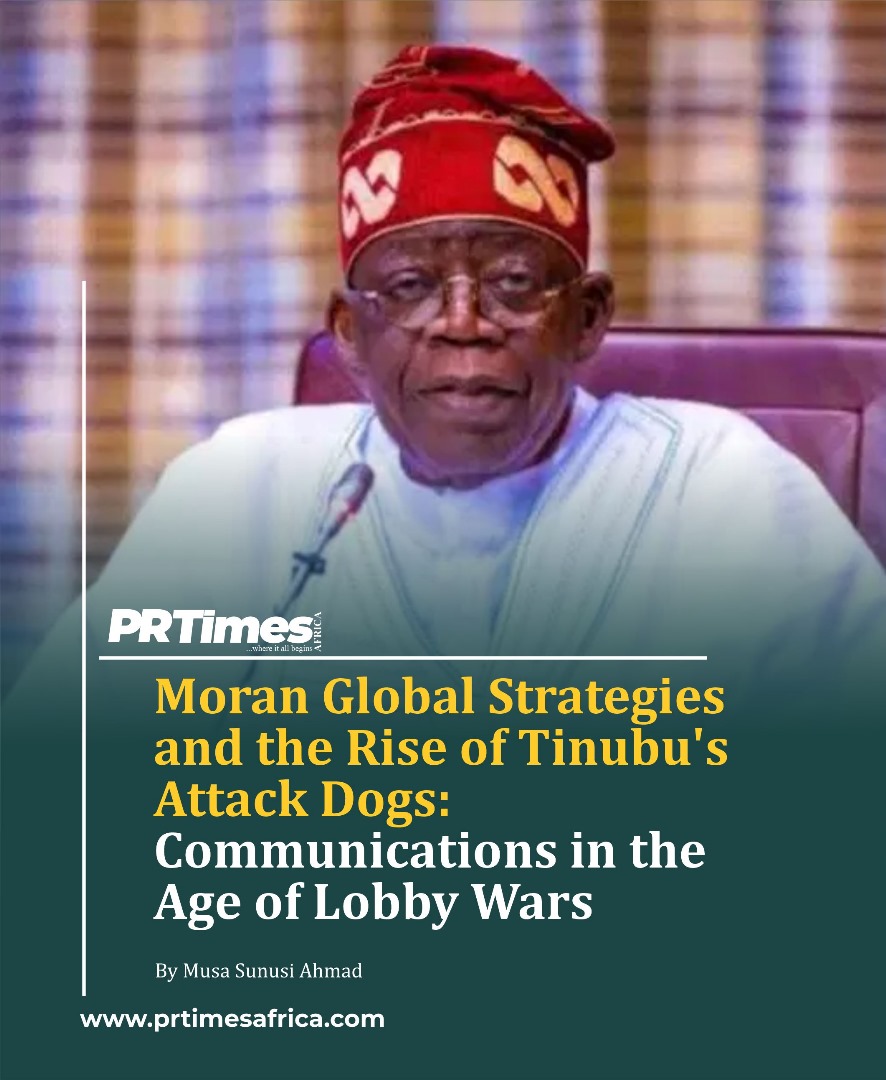
Moran Global Strategies and the Rise of Tinubu’s Attack Dogs: Communications in the Age of Lobby Wars
By Musa Sunusi Ahmad:
When U.S.-based lobbying firm Moran Global Strategies began making headlines in Nigerian political circles earlier this year, it didn’t take long for the machinery of government-affiliated public relations to swing into motion especially as it link to Biafra. What followed was predictable but troubling: a familiar barrage of attacks, counterattacks, and spin, this time deployed by a growing cadre of online and offline influencers many now dub “Tinubu’s Attack Dogs.”
While political communications has always had its aggressive edges, the current strategy raises serious questions for PR professionals, lobbyists, and policymakers alike: What happens when legacy attack-style messaging clashes with a globalized lobbying architecture? And is the aggressive defensive posture of state-affiliated communicators helping or hurting the Tinubu administration?
The Global Lobbying Game: Welcome to a New Arena
Moran Global Strategies, a firm with access to high-value U.S. political and diplomatic networks, was reportedly contracted by Nigerian stakeholders critical of the current administration. Their task? Shaping the narrative in Washington D.C., possibly influencing policy and perceptions at the State Department, Capitol Hill, and international media outlets.
For the Tinubu administration, the emergence of such a firm wasn’t merely a PR nuisance, it was seen as a threat to international credibility. But instead of quietly countering through backchannel diplomacy or soft power strategy, the response was loud, sharp, and relentless.
The Domestic Strategy: Defend, Attack, Distract
In what has become a pattern, the Nigerian digital media space was flooded with defensive op-eds, combative tweets, and orchestrated smear campaigns. A growing ecosystem of influencers, spokespersons, and anonymous accounts took up the task of discrediting the motives behind Moran Global’s client base, questioning the patriotism of the opposition, and painting the lobbying efforts as “unpatriotic” or even “foreign interference.”
This is classic attack PR, aggressively controlling the narrative by questioning the messenger instead of engaging with the message. It’s a strategy that has worked domestically in Nigeria, where loyalty often matters more than nuance. But on the international stage, this approach can backfire.
Why the “Attack Dog” Strategy Falls Flat Abroad
Unlike domestic audiences, international actors, especially in diplomatic, media, and lobbying circles, don’t respond well to emotional counter-narratives or perceived propaganda. They are trained to detect overreach. When spokespersons and affiliated influencers go on the offensive without offering substance or alternative facts, they risk reinforcing the very narratives they aim to dismantle.
Furthermore, firms like Moran Global thrive on transparency, connections, and credibility. They are not easily intimidated by public tirades. In fact, heavy-handed attacks may embolden them or attract more attention to their messaging.
A Smarter Strategy: Engagement Over Emotion
For a government serious about shaping its international image, engagement, not aggression, should be the preferred tool. This means:
– Leveraging strategic relationships via security attachés and foreign service operatives in Washington and London.
– Contracting rival lobbying firms that can quietly counter narratives and provide an alternative story to foreign policymakers and journalists.
– Using media diplomacy, not Twitter wars, to craft narratives that resonate with international stakeholders.
There is also a need for internal capacity building: PR strategy at this level requires professionals who understand geopolitical nuance, not just digital virality.
Beyond Noise, Toward Strategy
The episode with Moran Global Strategies highlights the evolving nature of political communications in an era of transnational influence warfare. As Nigeria’s global profile grows, the old tactics of silencing opposition through domestic noise will no longer suffice.
If the Tinubu administration wants to protect its image internationally, it must retire the “attack dog” approach and embrace a more sophisticated, strategic, and diplomatic communication model.
In the new global PR battlefield, winning hearts and minds isn’t about shouting the loudest, it’s about speaking the language of influence.