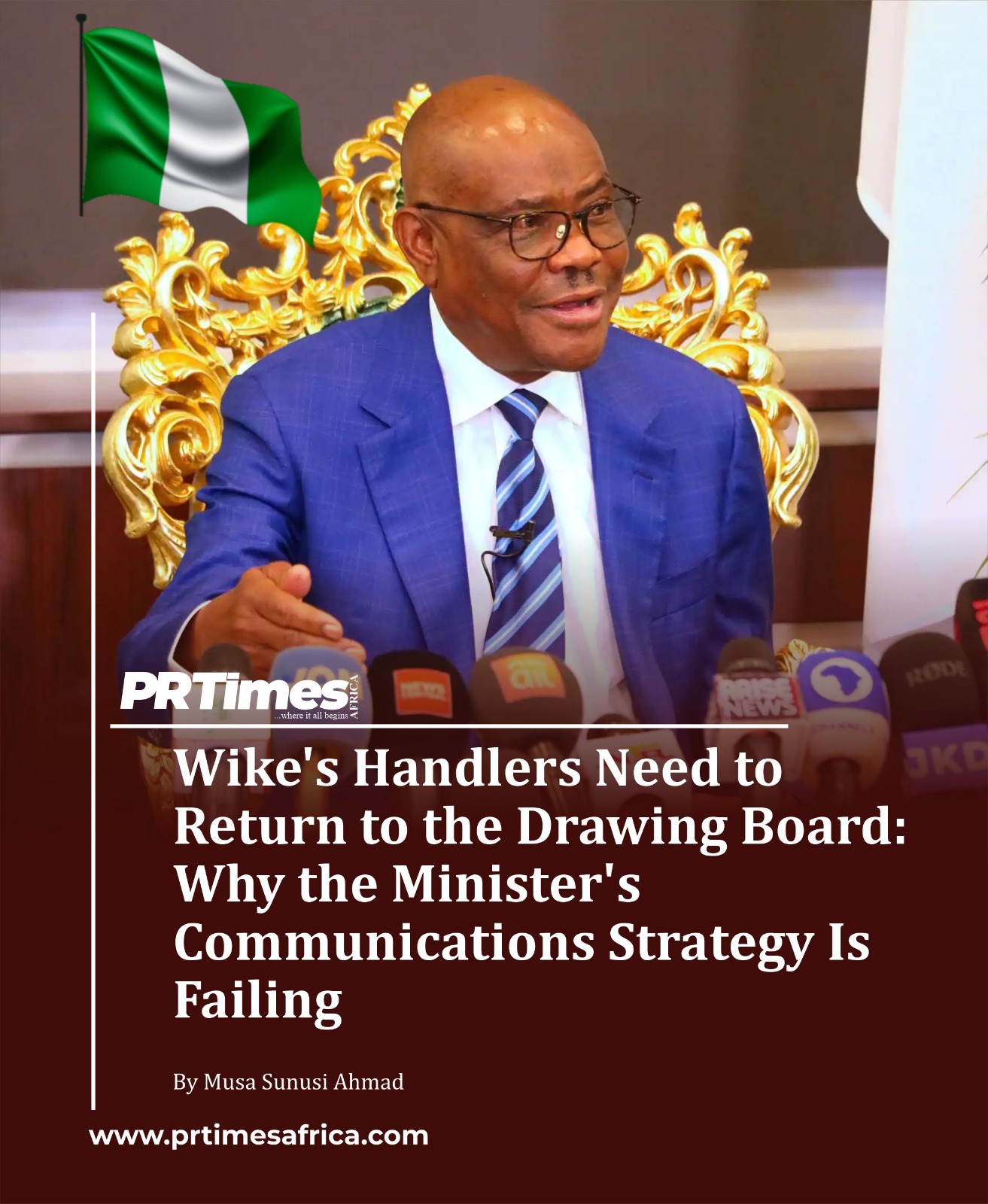
Wike’s Handlers Need to Return to the Drawing Board: Why the Minister’s Communications Strategy Is Failing.
By Musa Sunusi Ahmad
When a political figure dominates headlines as consistently as Nyesom Wike, it is easy to assume their
communications machinery is deliberate, coordinated, and airtight. Yet the opposite appears
increasingly true. The Minister of the Federal Capital Territory (FCT), known for his bold rhetoric and
political unpredictability, is now surrounded by a communications ecosystem that often seems reactive,
fragmented, and out of sync with both his style and his long-term intentions.
In an era where public perception can shift overnight, Wike’s handlers face an urgent need to return to
the drawing board and craft a communications strategy that is not only befitting of his political stature
but also reflective of the complexities and contradictions that shape his leadership.
A Communications Strategy That Has Lost Its Grip
The first sign of strategic fatigue is the reliance on unrewarding media chats, spontaneous press
engagements, and commentary that adds little value beyond sound bites. These occasional media
interactions, once a hallmark of Wike’s direct style, have become platforms where messages are neither
sharpened nor sustained.
The danger of such tactics is simple: message dilution. Inconsistent and uncoordinated communication
does more harm than silence, especially when it fuels confusion about intentions, policies, and goals.
For a leader as influential and polarizing as Wike, this lack of communications structure creates narrative
vacuums that critics, political opponents, and even allies are eager to fill.
Handlers Who Don’t Know the Destination Cannot Shape the Journey
A central problem seems to be that many of Wike's handlers simply do not understand his true
intentions or ultimate political goal. Political communication requires clarity of purpose, but when aides
and spokespeople speak without understanding the deeper vision, their messages become superficial,
defensive, or contradictory.
This disconnect is evident in:
– Mixed messaging on FCT policies
– Conflicting explanations on political alliances
– Reactive responses to controversies instead of proactive framing
A lack of narrative continuity between Wike’s past, present, and future political ambitions
In professional communications, alignment is not optional, it is foundational. Without it, the handlers
are left guessing, and the public is left confused.
Scrapping Media Chats: A Necessary but Incomplete Step
There has been talk in political circles about discontinuing the traditional Wike-style media chats. While
this may reduce miscommunication, it does not solve the underlying problem.
Scrapping media chats without replacing them with a structured communications architecture is like
removing the engine from a car and hoping momentum alone will keep it moving.
What Wike’s brand needs is not fewer engagements but smarter engagements:
– Carefully curated interviews
– Strategic op-eds
– Narrative-driven public addresses
– Data-backed policy briefings
– Audience-specific messaging frameworks
The goal isn’t to silence Wike, the goal is to manage the story.
Rebuilding the Communications Machine: What Needs to Change
To restore credibility and coherence, Wike’s communications team must undergo a strategic overhaul.
This includes:
1. A Unified Messaging Blueprint
Clear pillars that define Wike’s identity, policy direction, and long-term political vision.
Every spokesperson should speak from the same script, not the same sentences, but the same strategy.
2. Proactive Agenda Setting
Lead with announcements, not reactions.
Shape the conversation before others shape it for him.
3. Professionalization of the Comms Team
Shift from loyalists to communications professionals equipped with political communication expertise,
audience segmentation skills, and crisis communication experience.
4. Internal Clarity Before External Messaging
Wike himself must communicate his long-term intention, at least to his core strategists.
When handlers know the destination, they can chart a coherent route.
5. Replace Media Chats With Structured Communication Platforms
Not less communication, better communication.
A Leader With a Powerful Voice Needs a Powerful Strategy
Nyesom Wike is a political force, energetic, influential, charismatic, and often unpredictable. These
qualities can be strengths, but only when supported by a communications strategy strong enough to
harness them.
Right now, that foundation is shaky.
To stay ahead of the political narrative and maintain credibility in the public eye, his handlers must
return to the drawing board, rebuild the communications architecture, and adopt a strategy worthy of
his stature.
Because in modern politics, power is not only about what is done, but how it is communicated.
- Рейтинг онлайн игр
- Fifteen Voices, One Legacy: How Lagos Fashion Week Shaped Africa’s Creative Vanguard
- Merck Foundation CEO announce Rwandan winner of their Media Awards to break Infertility Stigma, Support Girl Education and Diabetes- Hypertension awareness
- NEWS UPDATE: East African Community (EAC) calls for cross-border cooperation to counter terrorism and transnational organized crime.
- Kenya/International Monetary Fund (IMF): Align Economic Reform with Rights
- NIGERIA, SPAIN PARTNER ON SPORTS DEVELOPMENT.