
By Godwin Green
Director, News and Strategy, PR Times Africa
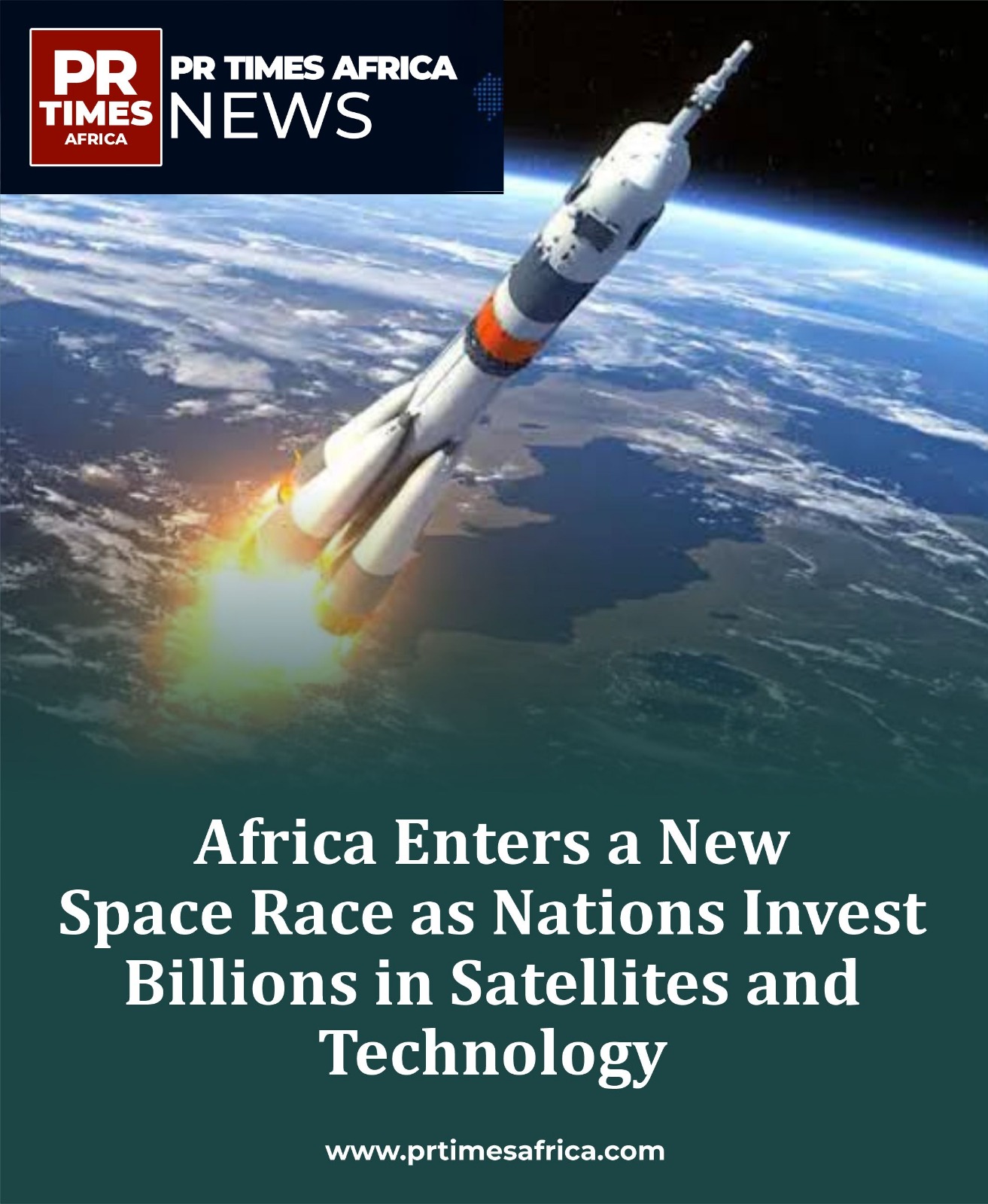
ABUJA — Africa is stepping deeper into the global space race, with a growing number of countries developing satellite programmes aimed at tackling challenges ranging from food security and climate change to communications, disaster management and national security.
Nearly 20 African countries now have satellites in orbit, while African governments are expected to spend about $828 million on space-related programmes in 2026, according to industry data.
The rapid expansion marks a significant shift for a continent that was largely absent from the early decades of the global space race.
Today, countries including Nigeria, South Africa, Egypt, Algeria, Morocco, Angola, Botswana, Uganda, Senegal and Djibouti are investing in satellites, space research and related infrastructure.
The African Union has also strengthened continental coordination through the African Space Agency, established to improve cooperation and develop Africa’s space capabilities.
From space to everyday life
For many African governments, the objective is not simply to put satellites into orbit.
Satellite technology is increasingly being used to monitor agricultural production, weather patterns, drought, wildfires, water resources, infrastructure and environmental changes.
In Angola, satellite technology is being used to improve communications across remote communities, while Botswana and Uganda are using satellite data for environmental and resource monitoring.
Senegal is also developing its satellite capabilities, with plans for a larger constellation that could provide detailed information for agriculture and other sectors.
The falling cost of satellite technology has helped accelerate the trend. Smaller satellites, known as nanosatellites, can be developed and launched at a fraction of the cost of traditional spacecraft.
A question of sovereignty
Beyond development, African countries are increasingly seeking greater control over the data they rely on.
Experts say dependence on foreign satellite imagery can be expensive and can leave countries vulnerable when geopolitical relationships change.
The growing African space sector is therefore becoming both an economic opportunity and a question of technological sovereignty.
But the expansion is also attracting competition from major global powers, including China, Europe and Japan, which are offering African countries technical assistance, financing and partnerships.
Africa’s geographical position also gives the continent strategic importance in global space operations.
With investment increasing and more countries developing national space programmes, analysts say Africa’s space ambitions are likely to continue expanding.
The challenge now is whether African countries can transform growing investment in satellites into home-grown technology, skilled jobs, scientific capacity and long-term economic value.
PR Times Africa will continue to follow Africa’s emerging role in the global space economy.
Source: Financial Times / Space in Africa