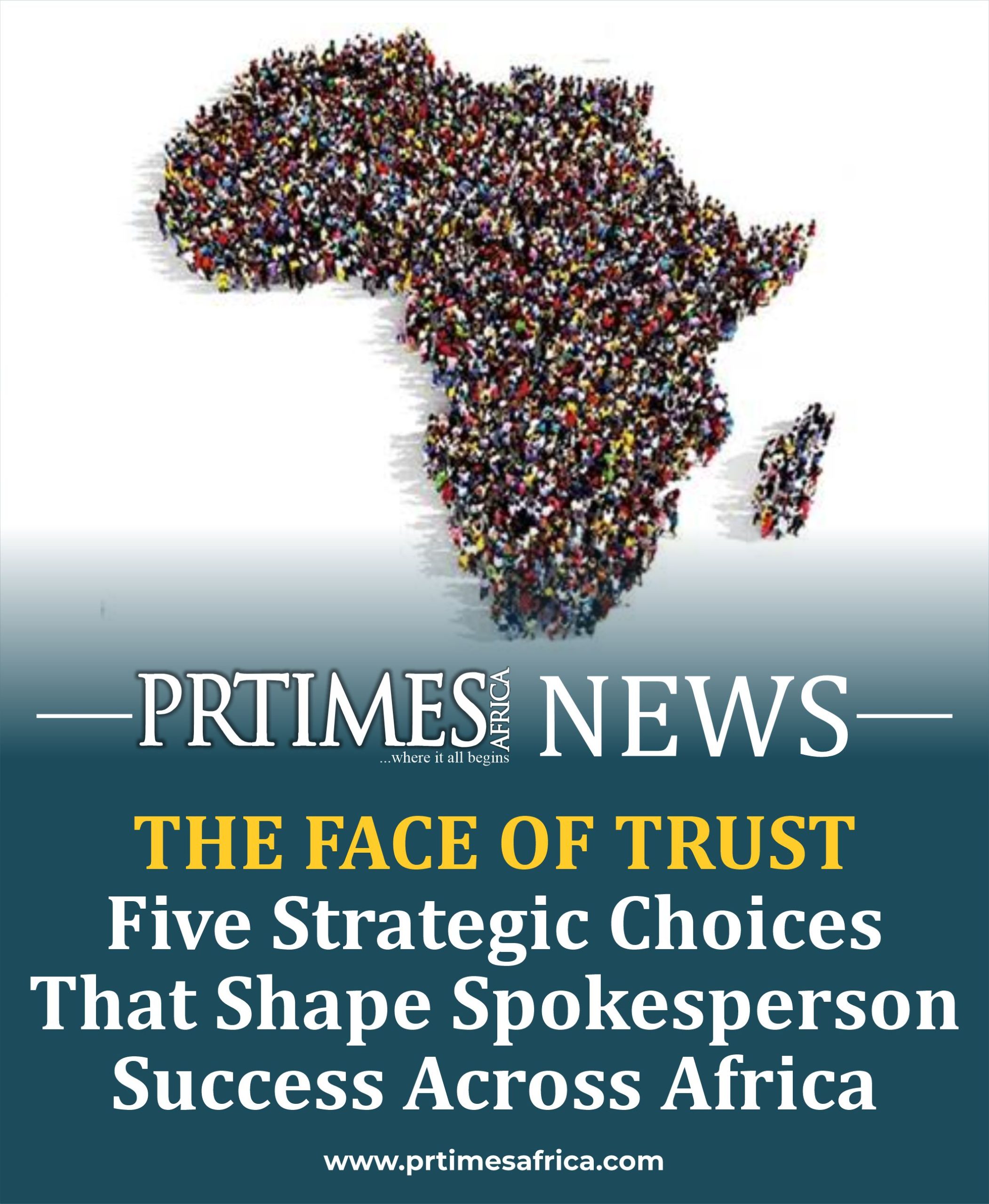
The Face of Trust
Five Strategic Choices That Shape Spokesperson Success Across Africa
By PR Times Africa Editorial
In an age where every statement can travel across continents in seconds, the role of a spokesperson has never been more critical. Across Africa, where governments, multinational corporations, financial institutions, development agencies, and private businesses operate under increasing public scrutiny, a spokesperson is no longer simply the individual who speaks on behalf of an organization. They have become the face of its credibility.
From Lagos to Nairobi, Johannesburg to Kigali, Accra to Windhoek, organizations are learning that reputation can be strengthened or damaged by a single interview, press briefing, or social media response. In a media environment shaped by 24-hour news cycles, digital platforms, and an increasingly informed public, choosing the right spokesperson is now a strategic leadership decision rather than an administrative one.
Yet many African organizations continue to approach media engagement the wrong way. When journalists request an interview, the default response is often to send the Chief Executive Officer, the Managing Director, or the most senior official available. Seniority, however, does not automatically translate into effective communication.
The most successful organizations understand that the best spokesperson is not always the most powerful person in the room. It is the individual best equipped to communicate with clarity, authority, empathy, and credibility.
Africa’s Media Landscape Has Changed
The African media industry has undergone a remarkable transformation over the past decade.
Traditional newspapers, radio stations, and television networks remain influential, but they now share the public space with digital newsrooms, investigative platforms, podcasts, online television channels, independent publishers, and millions of social media users.
Stories now break simultaneously across multiple platforms. A press conference in Abuja can become headline news in Nairobi, Cape Town, London, or Washington within minutes. Public reactions are immediate, and organizations are expected to respond just as quickly.
This evolution has raised the expectations placed on spokespersons.
Today’s audiences demand authenticity, transparency, and competence. They are quick to identify rehearsed talking points, evasive answers, and inconsistencies. More importantly, they expect organizations to communicate with empathy during crises and confidence during periods of growth.
In this environment, communication is no longer a support function it is a leadership responsibility.
Why Spokespersons Fail
Contrary to popular belief, ineffective spokespersons are rarely born. They are often the result of poor organizational decisions.
Some organizations appoint spokespersons based solely on rank, while others assume that technical expertise automatically translates into media competence. Many receive little or no media training, yet are expected to perform flawlessly during live interviews or crisis situations.
Others are sent into interviews without understanding the audience, the journalist’s perspective, or the broader context of the issue being discussed.
When communication breaks down, organizations frequently blame the individual rather than examining the strategy behind the appointment.
The question should not be, “Who is available to speak?”
It should be, “Who is best positioned to communicate this message?”
Five Strategic Choices That Shape Spokesperson Success
- Match the Messenger to the Moment
Not every issue requires the Chief Executive Officer.
A financial announcement may require the Chief Financial Officer. A regulatory issue may be better addressed by the Head of Government Relations. A cybersecurity breach should involve technical experts, while humanitarian initiatives may be best represented by programme directors or community leaders.
Choosing the right spokesperson demonstrates competence and reinforces credibility.
Organizations should build a pool of trained spokespersons capable of speaking on different issues rather than relying on a single executive.
- Train Before the Headlines Arrive
One of the greatest mistakes organizations make is waiting until a crisis occurs before preparing their spokesperson.

Media engagement is a skill that must be developed through continuous training.
Effective spokespersons understand how to simplify complex issues, remain calm under pressure, answer difficult questions, and communicate with empathy without compromising accuracy.
Across Africa, organizations that invest in regular media coaching are consistently better equipped to navigate periods of uncertainty.
Training should include interview simulations, crisis communication exercises, public speaking, message development, and digital media engagement.
- Build Credibility, Not Celebrity
The purpose of a spokesperson is not personal visibility.
It is institutional credibility.
Audiences respond positively to spokespersons who are knowledgeable, honest, and transparent. Attempts to dominate headlines or promote personal profiles often distract from the organization’s message.
The strongest spokespersons allow facts, evidence, and consistency to build their influence over time.
Trust is earned through performance, not publicity.
- Understand Africa’s Diverse Audiences
Africa is not a single market.
It is a continent of more than fifty countries, thousands of languages, diverse cultures, and different political, economic, and social realities.
An interview that resonates with audiences in Ghana may require a different tone in South Africa. Messages that appeal to investors may differ from those directed at local communities, regulators, or development partners.
Effective spokespersons understand these differences.
They communicate with cultural awareness, respect local contexts, and adapt their messaging without compromising organizational values.
This ability has become increasingly important as African organizations expand across borders through trade, investment, and regional integration initiatives such as the African Continental Free Trade Area (AfCFTA).
- Treat Every Media Engagement as a Long-Term Relationship
Media interviews should never be viewed as isolated events.
Every interaction contributes to an organization’s long-term reputation.
Professional spokespersons respect journalists’ deadlines, provide accurate information, acknowledge when facts are unavailable, and follow up when additional clarification is required.
Over time, these practices build trust between organizations and the media.
In Africa’s relationship-driven business environment, credibility often determines whether journalists return for future stories or seek information elsewhere.
The New Standard for African Leadership
The most respected institutions across Africa increasingly recognise that communication is part of governance.
Whether addressing investors, responding to regulatory developments, announcing new partnerships, or managing crises, effective communication reflects leadership quality.
A spokesperson should therefore be viewed not as a media representative alone but as a strategic asset capable of protecting reputation, strengthening public confidence, and reinforcing institutional trust.
Organizations that continue to treat spokesperson selection as an afterthought risk damaging years of reputation through a single poorly handled interview.
Looking Ahead
Africa’s growing influence in global business, diplomacy, technology, energy, and investment means its leaders will continue to face greater public attention and international scrutiny.
As expectations rise, organizations must move beyond choosing spokespersons based on titles or hierarchy. Instead, they should adopt a diagnostic approach identifying communication gaps, understanding where previous engagements have fallen short, and matching the right voice to the right moment.
Strong spokespersons do not emerge by chance. They are developed through deliberate strategy, continuous training, and a deep understanding of the audiences they serve.
At PR Times Africa, we believe that every organization has a story worth telling but only the right spokesperson can ensure it is told with clarity, credibility, and confidence. In Africa’s evolving media landscape, the strongest voice is not necessarily the loudest. It is the one that earns trust.