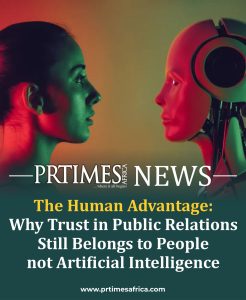
 The Human Advantage: Why Trust in Public Relations Still Belongs to People not Artificial Intelligence
Artificial Intelligence (AI) is transforming the communications industry at an unprecedented pace. From drafting press releases and analyzing audience sentiment to monitoring media coverage and generating social media content, AI has become a powerful tool in modern public relations. Across Africa, communications professionals are increasingly adopting AI to improve efficiency, reduce costs, and process vast amounts of information in seconds.
Yet despite its remarkable capabilities, one question continues to shape the future of public relations:
Can AI build trust?
The answer, at least for now, is no not on its own.
Trust has always been the foundation of public relations. It is the invisible thread connecting organizations with customers, governments with citizens, brands with communities, and leaders with stakeholders. While AI can accelerate communication, it cannot replace the uniquely human qualities that inspire confidence: empathy, ethical judgment, cultural understanding, emotional intelligence, and authentic relationships.
In Africa, where business success often depends as much on personal relationships as commercial transactions, the human element of public relations remains irreplaceable.
Trust Cannot Be Automated
Public relations has never been merely about distributing information. It is about creating understanding.
Trust is built through consistent actions, transparent communication, accountability, and genuine engagement. It develops over time through conversations, shared experiences, and credibility.
AI can draft a statement within seconds.
A human communicator understands when that statement should express compassion rather than confidence, humility rather than authority, or reassurance rather than technical accuracy.
During moments of crisis, stakeholders rarely remember every word an organization says. They remember how the organization made them feel.
That emotional connection remains uniquely human.
Africa’s Relationship-Driven Business Culture
Across much of Africa, business is rooted in relationships.
Whether negotiating partnerships in Nigeria, securing investments in Kenya, expanding manufacturing in South Africa, or engaging communities in Ghana, trust is often established through personal credibility long before contracts are signed.
- Leaders build influence by listening.
- Communities respond to authenticity.
- Employees remain loyal to organizations that communicate with respect and honesty.
- These relationship dynamics cannot be replicated by algorithms alone.
- AI may help organizations communicate faster, but meaningful relationships still require human presence, emotional intelligence, and cultural sensitivity.
- AI Understands Data. Humans Understand Context.
- Artificial Intelligence excels at recognizing patterns.
It can analyze millions of online conversations, identify emerging trends, measure public sentiment, and recommend communication strategies.
However, Africa is one of the world’s most culturally diverse continents, with thousands of languages, ethnic identities, traditions, and social norms.
A message that resonates positively in one country may be misunderstood in another.
Communicators must understand local customs, historical experiences, political sensitivities, and community expectations.
These nuances extend beyond data.
They require lived experience, empathy, and cultural awareness.
Reputation Depends on Ethical Judgment
Public relations frequently involves difficult decisions.
- Should an organization disclose information immediately or wait for verification?
- How should leadership respond to public criticism?
- When should an apology be issued?
- How much transparency is appropriate during sensitive investigations?
- These decisions involve ethics not simply information processing.
- AI can summarize facts.
- It cannot assume moral responsibility.
- Accountability belongs to people.
When organizations face public scrutiny, stakeholders expect leaders not machines to answer difficult questions and accept responsibility for decisions.
- Crisis Communication Requires Humanity
- Every organization eventually faces challenges.
- Operational failures.
- Product recalls.
- Executive misconduct.
- Natural disasters.
Community concerns.
During crises, organizations often turn to public relations professionals because effective communication can preserve trust even under immense pressure.
- AI can rapidly organize information and monitor public reactions.
- But crisis communication is not only about speed.
- It is about compassion.
- Communities affected by tragedy want empathy.
- Employees facing uncertainty want reassurance.
- Customers expect honesty.
- Investors seek credible leadership.
- These human expectations cannot be fulfilled through automation alone.
- The African Opportunity
- Africa is rapidly becoming one of the world’s fastest-growing digital economies.
- Young entrepreneurs are launching innovative startups.
- Governments are embracing digital transformation.
- Media consumption continues to evolve.
Artificial Intelligence offers enormous opportunities to strengthen communication across the continent.
It can help African organizations monitor global conversations, improve multilingual communication, analyze stakeholder expectations, and increase operational efficiency.
However, Africa also has an opportunity to demonstrate something equally important:
Technology should strengthen human relationships not replace them.
The continent’s traditions of community engagement, dialogue, and relationship-building provide valuable lessons for the global communications industry.
The Future Is Human-AI Collaboration
The future of public relations is not a competition between humans and artificial intelligence.
It is a partnership.
AI will continue to automate repetitive tasks, enhance research, generate insights, personalize communication, and improve efficiency.
Human professionals will continue to provide strategic thinking, ethical leadership, emotional intelligence, creativity, negotiation skills, and authentic relationship-building.
Organizations that combine both strengths will enjoy the greatest advantage.
- AI increases speed.
- Humans create trust.
- AI delivers information.
- Humans build credibility.
- AI predicts behaviour.
- Humans inspire confidence.
- A New Era for African Public Relations
As Africa’s influence in global business, diplomacy, innovation, and creative industries continues to grow, the continent’s communications professionals have an opportunity to redefine modern public relations.
Rather than viewing AI as a replacement for people, African organizations can embrace it as a strategic tool while preserving the values that have always defined effective communication: integrity, accountability, empathy, and meaningful human connection.
In doing so, they will build brands that are not only technologically advanced but also deeply trusted.
The Bottom Line
Artificial Intelligence is transforming the future of communication, but trust remains profoundly human.
In public relations, credibility is not created by algorithms. It is earned through integrity, strengthened by empathy, and sustained through authentic relationships.
For Africa’s governments, businesses, nonprofits, and institutions, the greatest competitive advantage in the AI era will not simply be adopting the latest technology it will be combining technological innovation with the timeless human qualities that inspire confidence.
Because while AI can help organizations communicate more efficiently, only people can build the trust that endures.