Day: August 21, 2026

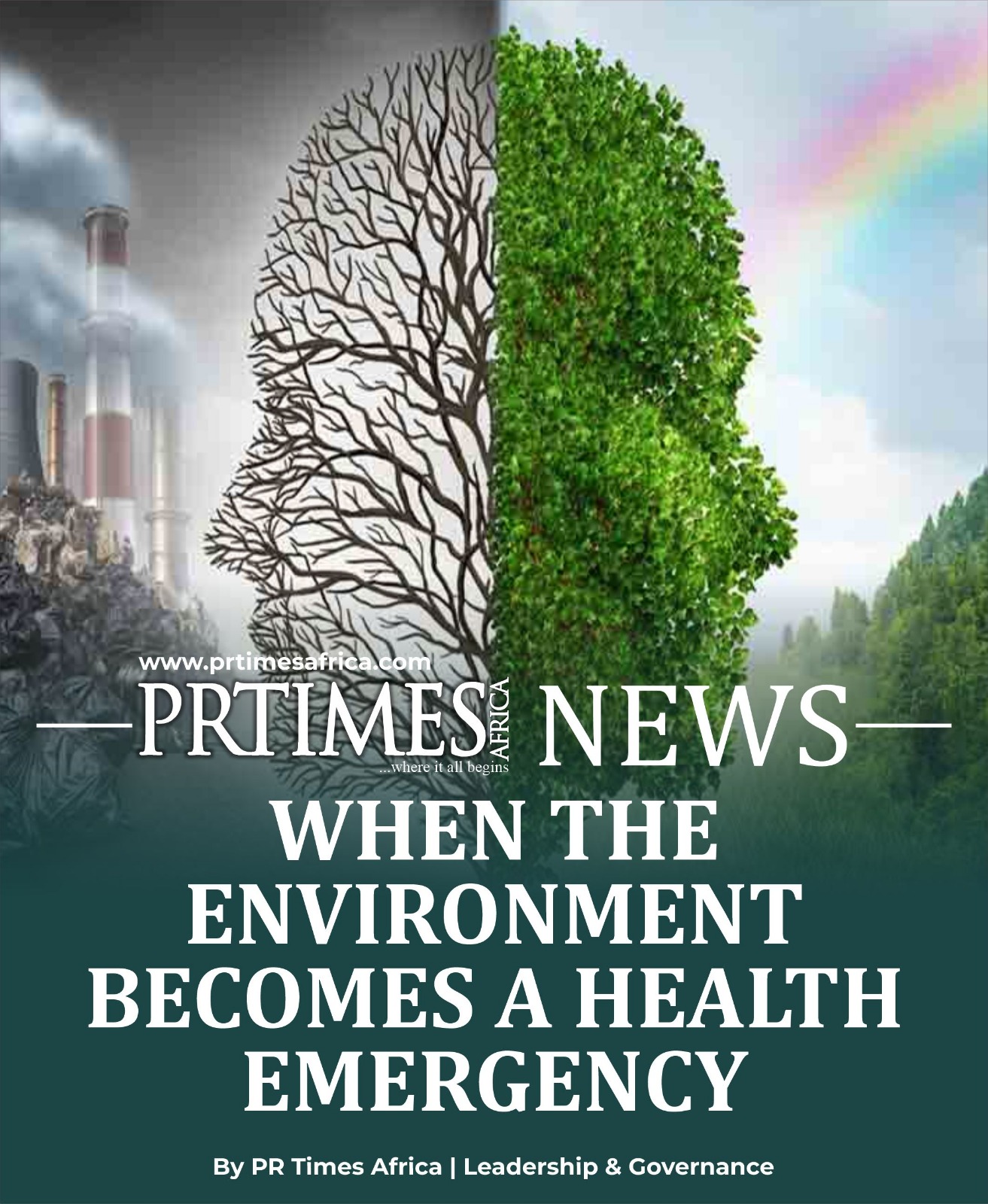
  • WHEN THE ENVIRONMENT BECOMES A HEALTH EMERGENCY

    WHEN THE ENVIRONMENT BECOMES A HEALTH EMERGENCY


    How Climate Change, Pollution, Flooding and Rapid Urbanisation Are Redefining Nigeria’s Public-Health Battle


    The environmental crisis is no longer happening around us. It is happening to us. From polluted air and unsafe water to overflowing waste, extreme heat and recurrent flooding, Nigeria is confronting a new generation of health risksand the Environmental Health Council of Nigeria is positioned at the centre of the conversation.


    By PR Times Africa | Leadership, Governance & Sustainability

    There was a time when environmental health could be discussed as a relatively simple matter of sanitation.

    • Waste collection.
    • Clean streets.
    • Public toilets.
    • Food hygiene.


    Today, that definition is no longer enough.

    Across Nigeriaand increasingly across Africathe environment is becoming one of the most important determinants of public health, economic productivity and quality of life.


    The warning signs are already visible.

    Floodwaters moving through communities. Plastic waste choking drainage systems. Smoke hanging over urban areas. Increasing heat. Polluted waterways. Unsafe food environments. Poor sanitation. Industrial emissions. Rapidly expanding cities struggling to keep infrastructure ahead of population growth.


    These are not isolated environmental problems.

    They are health risks.

    And they are becoming economic risks.

    They are governance risks.

    They are development risks.


    The question Nigeria must now confront is no longer whether environmental health matters.


    It is whether the country is prepared for what happens when environmental pressures begin to overwhelm the systems designed to protect human health.


    That is where the Environmental Health Council of Nigeria, EHCON, enters a much larger national conversation.


    THE ENVIRONMENT IS NO LONGER THE BACKGROUND

    For decades, environmental issues were often treated as something happening outside the healthcare system.

    • Public health belonged to hospitals, doctors, nurses, laboratories and disease-control agencies.
    • Environmental management belonged somewhere else.
    • That separation is becoming increasingly difficult to defend.
    • The air people breathe affects their health.
    • The water they drink affects their health.
    • The food they consume affects their health.
    • The buildings in which they live and work affect their health.
    • The heat they experience affects their health.
    • The drainage around their homes can influence their exposure to flood-related hazards.
    • The waste surrounding their communities can affect sanitation, air quality, water systems and disease risks.


    The World Health Organization identifies air pollution as one of the world’s major environmental health threats, with exposure linked to respiratory and cardiovascular disease and other serious health outcomes. WHO also describes climate and weather as already influencing health through heat, floods and changing patterns of infectious disease.


    The message is increasingly clear:

    Environmental policy is health policy.


    NIGERIA’S FLOODING PROBLEM IS BIGGER THAN WATER

    Few environmental issues illustrate this transformation more clearly than flooding.

    • Every rainy season, flooding becomes a familiar Nigerian headline.
    • Homes are submerged.
    • Roads disappear.
    • Businesses close.
    • Vehicles become stranded.
    • Communities are displaced.


    But the public-health consequences can continue long after the water recedes.


    Flooding can damage sanitation systems, contaminate water sources, disrupt healthcare access and create conditions that increase exposure to disease and other hazards.


    Nigeria is taking the risk seriously enough that the National Emergency Management Agency activated its National Emergency Operations Centre for the 2026 flood response in August, while urging people in flood-prone communities to heed warnings and relocate where necessary.


    The significance goes beyond emergency response.

    It raises a deeper question:

    Are Nigerian cities being designed for the climate they now experienceor the climate they used to have?


    That question belongs not only to emergency managers.

    • It belongs to urban planners.
    • Environmental professionals.
    • Public-health authorities.
    • Local governments.
    • And communities.


    Flooding is no longer simply a disaster-management story.

    It is an environmental-health story.


    THE DRAINAGE QUESTION

    • Consider the humble drainage channel.
    • On an ordinary day, it may appear to be an infrastructure issue.
    • During a major rainfall event, it can become a public-health issue.
    • When drainage systems are blocked by solid waste, poorly maintained or overwhelmed by rainfall, water has fewer places to go.
    • The consequences can spread quickly.
    • Roads become impassable.
    • Homes are flooded.
    • Waste is carried into waterways.
    • Contaminated water can enter areas where people live.
    • Businesses lose operating days.
    • Children may be exposed to unsafe surroundings.
    • Healthcare facilities can become harder to reach.
    • The cost is therefore much larger than the money required to clear a drain.
    • It is the cost of disruption.
    • The cost of disease.
    • The cost of lost productivity.
    • The cost of damaged infrastructure.
    • The cost to families.
    • The cost to government.
    • And ultimately, the cost to the economy.


    This is why environmental health must increasingly be viewed through an economic lens.


    THE AIR WE BREATHE

    • There is another crisis that is harder to see.
    • Air pollution does not always arrive with a dramatic headline.
    • There may be no floodwater outside the door.
    • No collapsed building.
    • No emergency siren.
    • But exposure can still carry serious consequences.


    Vehicle emissions, industrial activity, generators, household cooking fuels, open waste burning and other sources can contribute to poor air quality.


    Globally, WHO estimates that air pollution is associated with around seven million premature deaths annually. It also notes that almost the entire world’s population is exposed to air containing pollutant levels above its guideline recommendations.


    For Nigeria, the issue becomes particularly important because environmental exposure intersects with urban growth, energy challenges, transportation, industrialisation and waste management.


    The public conversation often asks:

    How much pollution can the economy tolerate?


    The better question may be:

    How much health damage can the economy afford?


    THE CITY IS BECOMING THE NEW FRONTLINE

    • Nigeria is urbanising rapidly.
    • Cities are engines of economic opportunity. They attract investment, talent, businesses and infrastructure.
    • But growth without adequate environmental planning can create new vulnerabilities.
    • More people means more housing.
    • More housing means more waste.
    • More vehicles mean greater pressure on transport systems and air quality.
    • More construction means greater pressure on land and infrastructure.
    • More commercial activity means greater environmental footprints.
    • And more impermeable surfaces can change how rainwater moves through cities.
    • The challenge is therefore not to stop urbanisation.
    • It is to make urbanisation healthier.
    • The cities of the future cannot simply be larger versions of today’s cities.
    • They must be cleaner, better planned, climate-resilient and designed around human health.


    That means environmental health professionals must have a stronger voice in conversations about urban development.


    CLIMATE CHANGE HAS CHANGED THE EQUATION

    • Climate change is no longer a distant scientific discussion.
    • It is increasingly a question of public health.
    • Extreme heat can place additional pressure on vulnerable populations.
    • Flooding can disrupt communities and expose people to environmental hazards.
    • Changing rainfall patterns can affect agriculture and water availability.
    • Climate-sensitive diseases can change their geographic and seasonal patterns.
    • Food systems can become more vulnerable.
    • Infrastructure can be tested by increasingly unpredictable weather.


    WHO’s African regional office notes that climate and weather already influence health outcomes across the continent, including deaths during heatwaves and disasters such as floods, as well as changing patterns of vector-borne diseases.


    And Africa faces a particularly difficult paradox.


    The continent has contributed relatively little to historical global greenhouse-gas emissions compared with major emitting regions, yet it is highly vulnerable to climate-related impacts.


    That makes climate resilience not simply an environmental issue.


    It is an issue of equity.


    AFRICA’S NEXT CLIMATE CHALLENGE

    Nigeria’s story is part of a much larger African story.


    Across the continent, cities are dealing with combinations of flooding, drought, heat, pollution, water insecurity, sanitation challenges and rapidly growing populations.


    The World Health Organization’s assessment of flooding across Southern Africa in early 2026 illustrates the scale of the challenge: heavy rainfall and cyclones since December 2025 affected an estimated 1.5 million people across several countries, with hundreds of deaths and large-scale displacement.


    Meanwhile, Africa is entering a period of heightened climate uncertainty.


    In July 2026, the African Development Bank warned that a potential severe El Niño could expose African economies to between $10 billion and $20 billion in economic losses, while threatening food and water security and increasing pressure on vulnerable communities.


    This changes the conversation.

    Climate resilience is no longer simply about protecting forests or reducing emissions.

    • It is about protecting economies.
    • Protecting food systems.
    • Protecting water.
    • Protecting workers.
    • Protecting children.
    • Protecting cities.
    • And protecting human health.


    THE ENVIRONMENTAL HEALTH PROFESSIONAL OF TOMORROW

    This changing environment demands a new kind of environmental health professional.

    • The professional of tomorrow may need to understand far more than traditional sanitation.
    • They may need knowledge of climate resilience.
    • Urban planning.
    • Food systems.
    • Occupational health.
    • Waste-to-value models.
    • Pollution monitoring.
    • Environmental technology.
    • Risk communication.
    • Emergency preparedness.
    • Sustainable development.
    • And emerging technologies.


    The environmental health profession therefore has the potential to become one of the most multidisciplinary professions in Nigeria’s future development.


    That is precisely why professional regulation and standards matter.


    EHCON’s mandate includes setting standards for environmental health practice, regulating and licensing practitioners, establishing professional codes and working with stakeholders on compliance. Its stated vision is to position environmental health practice as the fulcrum of public health in Nigeria.


    That vision is becoming increasingly relevant.


    EHCON’S BIGGER OPPORTUNITY

    The question for EHCON is whether it can become more than a regulator.

    • There is an opportunity to become a national thought leader.
    • A knowledge institution.
    • A professional standard-setter.
    • A bridge between government and industry.
    • A partner to universities and research institutions.
    • A voice in climate-health policy.
    • And potentially a Nigerian contributor to the wider African environmental-health conversation.


    The Council’s mandate already gives it a foundation for this role.


    But the environmental challenges facing Nigeria are moving faster than traditional institutional boundaries.


    The next generation of environmental health leadership will require collaboration across ministries, regulators, local governments, private companies, universities, development institutions and communities.


    No single institution can solve the environmental-health challenge alone.


    But institutions can help create the standards, knowledge and partnerships that make solutions possible.


    THE BUSINESS OF A HEALTHIER ENVIRONMENT

    There is also an economic opportunity hiding inside the environmental crisis.

    • Waste is not merely waste.
    • It can become a resource.
    • Plastic can become recycled material.
    • Organic waste can become compost or energy.
    • Industrial by-products can potentially become inputs for other production systems.
    • Waste-management companies can create jobs.
    • Environmental technology can create new businesses.
    • Green construction can reduce long-term costs.
    • Cleaner production can improve efficiency.
    • Climate-resilient infrastructure can protect investments.
    • For investors, environmental health is increasingly connected to risk management.
    • For companies, it is connected to reputation.
    • For governments, it is connected to development.
    • For communities, it is connected to survival.
    • And for entrepreneurs, it can become an emerging market.


    This is where environmental health meets the private sector.


    THE CORPORATE RESPONSIBILITY QUESTION

    Nigeria’s environmental future cannot be built by government alone.

    • Mining companies.
    • Oil and gas operators.
    • Construction companies.
    • Food businesses.
    • Property developers.
    • Logistics companies.
    • Waste-management firms.
    • Technology companies.


    All have environmental footprints.


    The future of corporate responsibility must therefore move beyond occasional clean-up exercises and publicity-driven environmental campaigns.


    Businesses should increasingly think about environmental performance as part of their core operating model.


    • How much waste does a company generate?
    • How is it disposed of?
    • What happens to its wastewater?
    • What is the quality of its workplace?
    • How does it protect employees?
    • What happens to its environmental footprint across the supply chain?
    • What risks could climate change create for its operations?


    These questions belong in boardrooms.


    Because environmental risk is increasingly becoming business risk.


    FROM COMPLIANCE TO COMPETITIVENESS

    There is an important shift Nigeria can make.

    • Environmental compliance should not be viewed merely as an obligation imposed by regulators.
    • It can become a competitive advantage.
    • Companies that reduce waste can lower costs.
    • Companies that improve workplace environments can strengthen employee wellbeing.
    • Companies that invest in cleaner production can improve efficiency.
    • Companies that manage environmental risks effectively can strengthen investor confidence.
    • Companies that build credible sustainability strategies can become more attractive to international partners.


    This is where environmental health moves into the language of modern business.


    ESG.

    • Climate resilience.
    • Circular economy.
    • Responsible investment.


    These are no longer conversations confined to international boardrooms.


    They are increasingly relevant to African businesses.


    THE DATA GAP

    But Nigeria faces another challenge: information.

    • You cannot manage what you cannot measure.
    • How much waste is being generated?
    • Where are the highest-risk communities?
    • Which cities face the greatest environmental-health exposure?
    • Where are pollution levels highest?
    • What environmental risks are affecting workers?
    • Which communities face the greatest flood exposure?
    • What diseases are associated with specific environmental conditions?
    • Which interventions actually work?
    • Better environmental health policy requires better data.


    This creates an opportunity for EHCON, universities, technology companies and government agencies to build stronger environmental-health intelligence systems.


    Imagine a Nigeria Environmental Health Outlook that tracks environmental risks across states.


    Imagine a national dashboard showing environmental-health indicators.


    Imagine cities using data to identify vulnerable communities before disasters occur.


    Imagine environmental health professionals using digital tools and predictive analytics to identify emerging risks.


    That is the future.


    TECHNOLOGY WILL CHANGE ENVIRONMENTAL HEALTH

    Artificial intelligence, satellite imagery, sensors, geospatial mapping and digital reporting are already changing the way environmental risks can be monitored.

    • Nigeria should not approach environmental health solely with yesterday’s tools.
    • Technology could help identify illegal dumping.
    • Track air quality.
    • Map flood-prone areas.
    • Monitor environmental compliance.
    • Predict environmental risks.
    • Improve waste collection.
    • Map disease and environmental exposure.
    • Support emergency response.


    EHCON itself has already highlighted AI-driven operations and predictive analysis through professional training initiatives, suggesting that technology is becoming part of the Council’s evolving professional agenda.

    • The opportunity is to move from reactive environmental health to predictive environmental health.
    • Instead of waiting for a crisis, identify the risk.
    • Instead of responding after flooding, map vulnerable communities.
    • Instead of discovering pollution after damage occurs, monitor exposure continuously.
    • Instead of treating environmental health as paperwork, turn it into intelligence.


    THE HUMAN COST

    Yet behind every environmental statistic is a person.

    • A child breathing polluted air.
    • A mother searching for safe water.
    • A trader working in extreme heat.
    • A construction worker exposed to environmental hazards.
    • A family whose home floods every rainy season.
    • A farmer facing unpredictable rainfall.
    • A business owner whose shop is destroyed by flooding.
    • A community living beside polluted water.


    This is why the environmental-health conversation cannot become purely technical.


    It must remain human.

    Because the ultimate objective of environmental health is not cleaner statistics.


    It is healthier lives.


    THE NEXT GREAT PUBLIC-HEALTH INVESTMENT

    Nigeria has traditionally invested heavily in the treatment side of healthcare.

    • Hospitals matter.
    • Doctors matter.
    • Medicines matter.
    • Emergency care matters.


    But prevention matters too.


    If environmental conditions contribute to illness, then improving those conditions becomes part of healthcare.

    • Clean water is preventive healthcare.
    • Safe food is preventive healthcare.
    • Proper sanitation is preventive healthcare.
    • Clean air is preventive healthcare.
    • Healthy workplaces are preventive healthcare.
    • Effective waste management is preventive healthcare.
    • Climate-resilient communities are preventive healthcare.


    This is perhaps the most important conceptual shift Nigeria can make.


    The hospital should not be the first line of defence.


    The environment should be.


    FROM NIGERIA TO AFRICA

    Nigeria has the population, institutions, professional talent and economic scale to become an African leader in environmental health.

    • The opportunity is not simply to solve Nigeria’s problems.
    • It is to develop solutions that can travel.
    • African cities are facing similar pressures.
    • What Nigeria learns about urban sanitation could benefit other African cities.
    • What Nigeria develops in waste management could become an exportable model.
    • What Nigerian professionals learn about climate resilience could contribute to continental knowledge.
    • What EHCON builds in professional standards could help strengthen the environmental-health profession beyond Nigeria.
    • The opportunity is therefore larger than national regulation.
    • It is African leadership.


    A NEW ROLE FOR EHCON

    The environmental-health challenge creates an opportunity for EHCON to redefine its public identity.

    • Not by abandoning its regulatory responsibilities.
    • But by expanding the conversation around them.
    • EHCON can help make environmental health visible.
    • It can convene government, academia and business.
    • It can promote research.
    • It can strengthen professional development.
    • It can support public education.
    • It can encourage innovation.
    • It can help establish stronger standards.
    • It can contribute to national climate-health discussions.
    • It can build partnerships with international institutions.
    • And it can help Nigeria develop a new generation of environmental-health professionals eq
    • And it can help Nigeria develop a new generation of environmental-health professionals equipped for the realities of the 21st century.
    • Its own visionto position environmental health as the fulcrum of public healthmay be more relevant now than at any point in the profession’s modern history.


    THE QUESTION NIGERIA MUST ANSWER

    The environmental crisis is no longer somewhere in the future.

    It is already influencing the way people live, work, travel, eat and raise their families.

    • The floods are real.
    • The heat is real.
    • The pollution is real.
    • The waste challenge is real.
    • The pressure on cities is real.
    • The climate risk is real.

    The question is whether Nigeria will continue treating each problem separatelyor recognise that they are connected.

    • Because a flooded city is not only an infrastructure problem.
    • A polluted community is not only an environmental problem.
    • Unsafe food is not only a regulatory problem.
    • Poor sanitation is not only a municipal problem.
    • Extreme heat is not only a weather problem.
    • They are all, ultimately, human-health problems.


    THE FUTURE STARTS BEFORE THE HOSPITAL

    The most important environmental-health intervention may never happen inside a hospital.

    • It may happen when a drainage channel is kept clear.
    • When waste is properly managed.
    • When water is protected.
    • When food is safely prepared.
    • When an industrial facility controls its emissions.
    • When a worker is protected from environmental hazards.
    • When a city is designed to withstand extreme rainfall.
    • When technology identifies a risk before it becomes a disaster.
    • When a company sees sustainability not as a public-relations exercise but as a business imperative.
    • And when policymakers recognise that environmental health belongs at the centre of national development.


    That is the bigger story Nigeria now faces.

    The environment is not simply where people live.

    It is one of the most powerful determinants of how people liveand how long they live.


    For Nigeria, the next chapter of public health may therefore not be written only in hospitals and laboratories.

    • It will be written in cities.
    • In communities.
    • In factories.
    • In markets.
    • In schools.
    • In drainage systems.
    • In boardrooms.


    And increasingly, in the institutions responsible for protecting the environments in which Nigerians live and work.


    EHCON has an opportunity to help lead that transformation.

    • The challenge is enormous.
    • But so is the opportunity.
    • Because if Nigeria wants a healthier population, it may first have to build a healthier environment.
    • The future of public health begins long before the hospital door.


    EDITOR’S NOTE

    Nigeria’s environmental-health conversation is entering a critical period. WHO maintains a dedicated 2025 environmental-health country profile for Nigeria, while Nigerian institutions are increasingly confronting the intersection of flooding, climate, disaster preparedness and public health.


    The opportunity now is to move environmental health from the margins of national policy into the centre of public health, climate resilience, economic development and sustainable urbanisation.


    For EHCON, that could represent more than institutional visibility.


    It could represent national leadership.

  •  AFRICA’S STORY SHOULD NOT NEED CNN’S PERMISSION TO BE GLOBAL

     AFRICA’S STORY SHOULD NOT NEED CNN’S PERMISSION TO BE GLOBAL


    The Dangote Question: Why Africa’s Biggest Brands Must Start Building the Media Platforms That Will Tell Africa’s Story to the World


    There is nothing wrong with taking an African story to CNN.


    The real question is: why must an African success story leave Africa before the world considers it important?


    The conversation surrounding Aliko Dangote, Africa’s most prominent industrialists and one of the continent’s most globally recognised business figures, raises a much bigger question about the future of African media, corporate reputation and the ownership of Africa’s narrative.


    When a businessman of Dangote’s stature appears on an international platform such as CNN, the exposure is undoubtedly valuable. It places his story before a global audience of investors, policymakers, business leaders and consumers.


    But there is another side to the equation.

    What happens to the African media platforms capable of telling that same story?


    What happens to NTA, Arise, TVC, SABC and the many African broadcasters and publishers working to build internationally respected media brands?


    You Cannot Build What You Refuse to Use


    Africa cannot continuously complain that its media lacks international influence while its biggest businesses, institutions and personalities reserve their most important stories for international platforms.


    If Africa’s most successful entrepreneurs consistently choose CNN, BBC and other global networks for their defining interviews, those platforms naturally become stronger.

    • They gain exclusive content.
    • They gain African audiences.
    • They gain advertising opportunities.
    • They gain influence.


    Meanwhile, African media organisations struggle to obtain the premium stories, access and investment necessary to compete internationally.


    This is not an argument against CNN.

    It is an argument for Africa.


    What If Africa’s Biggest Stories Were Told at HomeThen Taken to the World?


    Imagine Dangote giving an exclusive interview to an African media organisation.

    • Imagine NTA carrying the story across Nigeria.
    • Arise and TVC amplifying it.
    • SABC taking it across Southern Africa.
    • African digital platforms distributing it across the continent.


    Then CNN, BBC and other international networks picking up the story from Africa.


    That would change the direction of the narrative.


    Instead of Africa waiting for international media to validate its stories, international media would be coming to Africa for stories already being shaped by African media.


    That is the difference between simply being covered and actually owning the narrative.


    Local Does Not Mean Small


    One of Africa’s biggest misconceptions is that local media automatically means limited media.


    It shouldn’t.


    NTA is Nigerian. SABC is South African. Arise and TVC are African platforms.


    But their geographical origins should not determine the size of their ambitions.


    An African broadcaster should be capable of producing content that reaches Washington, London, Johannesburg, Dubai, New York and beyond.


    The question is not whether African media can become global.


    The question is whether Africa’s biggest brands are willing to help make it happen.


    Reputation Is Bigger Than Publicity


    This is where corporate reputation management becomes important.


    A major interview is not simply about publicity.


    It is about positioning.


    Where your story appears communicates something about how you see yourself.


    Who tells your story influences how your audience understands you.


    And the platforms you consistently use help determine which media ecosystems become stronger.


    For African businesses expanding internationally, reputation is no longer a local issue.

    • It affects investment.
    • It affects partnerships.
    • It affects government relations.
    • It affects consumer confidence.
    • It affects how the world perceives the country from which the company comes.


    Dangote Is Bigger Than Dangote

    When the world sees Dangote, it is not necessarily seeing only one businessman.It can also be seeing Nigeria.


    His industrial achievements can influence perceptions of Nigerian manufacturing, entrepreneurship, investment and economic potential.


    That is why the media platform through which African success stories are communicated matters.


    When an African company becomes globally recognised, its reputation can become part of the reputation of its countryand eventually part of the reputation of Africa itself.


    Africa Must Stop Being Only a Subject of Global Media


    For decades, Africa has often been presented to the world through narratives created outside the continent.

    • Political instability.


    These realities exist and deserve responsible reporting but they are not the entire African story.There is another Africa.

    • An Africa of industrialists.
    • Technology entrepreneurs.
    • Creative industries.
    • Infrastructure developers.
    • Young innovators.
    • And companies competing in international markets.


    Who tells those stories matters.

    Africa should not simply be a subject of international journalism.

    Africa should become a powerful source of global journalism.

    The Bigger Opportunity


    Perhaps the conversation should therefore not be:

    “Why did Dangote choose CNN?”


    The more important question is:

    “Why haven’t African media platforms become strong enough, attractive enough and internationally positioned enough for Africa’s biggest brands to make them their first choice?”


    That responsibility belongs to everyone.


    African media organisations must improve their journalism, technology, production quality and global distribution.


    Governments must create an environment where credible media can thrive.


    Corporations must invest in African media.


    And Africa’s wealthiest and most influential people must understand that choosing African media is more than buying publicity.


    It is investing in the continent’s information infrastructure.


    The CNN Effect Must Become the Africa Effect

    CNN became a global brand because it built an audience and earned international attention.


    African media can do the same.But it needs the confidence and participation of Africa’s biggest institutions, businesses and personalities.


    The next generation of African leaders should not only ask:

    “Which international network can give me global exposure?”


    They should also ask:

    “How can my success help build an African platform capable of giving the next generation global exposure?”Because Africa does not lack stories.


    Africa lacks enough global platforms telling those stories from an African point of view.


    And perhaps that is the real lesson from the Dangote debate.


    Africa’s story should not need CNN’s permission to be global.


    The continent must build, support and trust the platforms capable of taking that story to the world.


    Because if Africa’s biggest brands do not believe in African media, why should the rest of the world?

  •                                      AFRICA MUST STOP LOBBYING FOR ACCESS AND START NEGOTIATING FROM STRENGTH

      AFRICA MUST STOP LOBBYING FOR ACCESS AND START NEGOTIATING FROM STRENGTH


    The billions Africa spends seeking influence in Washington raise a bigger question: Why is a continent rich in minerals, markets, people and strategic resources still behaving like a supplicant on the global stage?


    Across Africa, governments are spending substantial sums on Washington-based lobbying firms to strengthen relationships with the United States and, increasingly, to gain access to the Trump administration.


    Kenya reportedly agreed to pay $175,000 a month to Continental Strategy, a firm founded by former Trump administration official Carlos Trujillo, ahead of President William Ruto’s engagement with Washington.


    Nigeria entered a reported $9 million agreement with DCI Group to communicate its security efforts and seek continued U.S. support for counterterrorism cooperation. The contract was filed under the U.S. Foreign Agents Registration Act.


    Rwanda’s state development board signed a lobbying agreement worth $80,000 a month with Yorktown Solutions. Morocco spent a reported $3.49 million on U.S. lobbying in 2025, much of it connected to its effort to maintain American backing for its position on Western Sahara.


    Somalia also signed a $600,000 annual agreement with BGR Group, a Washington lobbying firm with Republican connections.


    Angola, meanwhile, has been reported as paying $312,500 a month to Squire Patton Boggs in a lobbying arrangement linked to promoting the Lobito Corridor and related economic interests.


    These figures should provoke more than political controversy.

    They should provoke a fundamental conversation about African leadership.


    The Question Africa Must Ask

    There is nothing inherently wrong with diplomatic engagement or professional lobbying. Governments everywhere employ public-affairs firms to explain their policies, build relationships and advance national interests.


    The problem begins when lobbying becomes a substitute for strategic power, credible institutions, economic leverage and serious diplomacy.


    Why should African governments have to spend millions of dollars to convince powerful countries to pay attention to a continent that possesses some of the world’s most important natural resources, strategic waterways, minerals, agricultural potential and rapidly growing consumer markets?


    • Africa is home to critical minerals required for the global energy transition.
    • Africa controls strategic maritime routes.
    • Africa has some of the world’s largest reserves of cobalt, copper, lithium, uranium, manganese, oil and gas.
    • Africa has a population of more than a billion people and one of the world’s youngest consumer markets.


    Yet too often, African governments arrive in Washington asking:

    “How can we gain access?”

    The question should increasingly be:

    “What does America want from Africa, and what is Africa prepared to negotiate in return?”


    From Lobbying to Leverage

    This is where Africa needs a new turn.

    The continent cannot continue approaching international relations as a collection of individual countries competing for attention from powerful foreign capitals.


    Africa needs collective bargaining power.

    Imagine an African diplomatic and economic strategy in which access to strategic minerals, infrastructure projects, energy resources, major markets and investment opportunities becomes part of a coordinated negotiation.


    Imagine African leaders saying:

    You want our minerals? What value are you bringing to Africa?

    You want access to our markets? What jobs, technology and industrial capacity will Africa receive?

    You want strategic partnerships? What infrastructure and security commitments come with them?


    That is not confrontation.That is diplomacy from a position of strength.

    • Africa’s Resources Should Create Power
    • The tragedy is not that African countries are engaging Washington.
    • The tragedy would be if Africa’s enormous resources continue to generate strategic advantages for everyone except Africans.


    For decades, Africa has exported raw materials while importing finished products.

    • It has exported minerals while importing technology.
    • It has exported crude oil while importing refined petroleum products.
    • It has provided markets while struggling to build globally competitive African companies.
    • And now, in some cases, governments are spending millions of dollars lobbying foreign political networks for influence.


    That model deserves to be challenged.

    • A New Generation of African Leadership
    • Africa does not necessarily need less diplomacy.
    • It needs better diplomacy.
    • It does not need to withdraw from Washington.
    • It needs to enter Washington with a clearer understanding of its own value.
    • African leaders should build permanent strategic relationships with Washington, Beijing, Brussels, Moscow, Riyadh, New Delhi and other global centresnot as petitioners, but as partners.


    The African Continental Free Trade Area should become more than a trade agreement. It should become a source of geopolitical leverage.


    African countries should coordinate positions on critical minerals, energy, agriculture, technology, defence, infrastructure and investment.


    The African Union should be empowered to help member states negotiate major strategic partnerships.


    And African governments should invest more aggressively in their own diplomatic intelligence, policy research, global communications and international media capacity.


    Because if Africa does not tell its own story and define its own interests, somebody else will.


    The Real Cost Is Bigger Than the Lobbying Bill

    • The millions spent on lobbying are only part of the issue.
    • The deeper cost is psychological.
    • A continent that repeatedly approaches the world’s major powers seeking approval risks reinforcing an outdated perception of Africa as dependent rather than decisive.
    • Africa must move from aid-seeking diplomacy to investment diplomacy.
    • From access-seeking politics to partnership politics.
    • From individual bargaining to continental strategy.
    • From exporting raw materials to building value chains.
    • And from asking the world to determine Africa’s future to Africa determining its own future.


    The New African Question

    The debate should therefore not simply be about how much Kenya, Nigeria, Somalia, Rwanda, Morocco or Angola spend on Washington lobbyists.


    The bigger question is:

    What would happen if Africa invested those same resources in building the institutions, industries, infrastructure, technology, diplomatic capacity and continental partnerships that would make foreign powers compete for African attention?


    That is the leadership conversation Africa needs.

    The world does not need Africa to become anti-American.


    • It does not need Africa to become anti-Chinese or anti-European.
    • It needs Africa to become pro-African.
    • A confident Africa should be open to every serious partnerbut dependent on none.
    • The next chapter of African leadership must therefore be about leverage, dignity, strategic bargaining and economic sovereignty.


    Africa has spent generations asking the world to invest in its future.

    Perhaps it is time for Africa to build enough power that the world has to negotiate for a place in Africa’s future.

    Africa does not need a seat at someone else’s table.

    Africa needs to build a table powerful enough that the world comes to negotiate.


  •                                                      WHY AFRICA’S NEXT GENERATION MUST LEAD THE DISASTER-RESILIENCE REVOLUTION

         WHY AFRICA’S NEXT GENERATION MUST LEAD THE DISASTER-RESILIENCE REVOLUTION


                                                                                                        PR Times Africa’s Pan-African Disaster Awareness & Youth Resilience Initiative


    Africa’s flood crisis is becoming more than an emergency-response challenge. It is a test of leadership, infrastructure, technology and the continent’s ability to prepare before lives are lost. PR Times Africa is responding with a new youth-focused movement designed to turn awareness into action.


    Floods across Africa are leaving behind a familiar cycle: communities are overwhelmed, homes and businesses are destroyed, roads become impassable, livelihoods disappear and governments mobilise after the damage has already been done.


    But the bigger question is not simply how Africa responds to disasters.

    It is whether Africa is preparing for them.

    That distinction matters.


    Across the continent, extreme weather, rapid urbanisation, inadequate drainage, environmental degradation and vulnerable infrastructure are increasing the consequences of flooding. The African Development Bank has described flooding as a growing threat to communities, infrastructure and economic activity across the continent.


    For Africa’s rapidly growing young population, the challenge is particularly significant.The continent’s youth are not only among those most affected by climate-related disruptions. They are also among Africa’s greatest assets for building a more resilient future.


    This is where PR Times Africa Media Ltd sees an opportunity.


    FROM REPORTING DISASTERS TO PREPARING COMMUNITIES

    PR Times Africa is proposing a Pan-African Disaster Awareness and Youth Resilience Initiative built around one powerful idea:


    BEFORE THE WATER RISES.

    The objective is straightforward: take disaster-preparedness information beyond government offices and emergency agencies and put it directly into the hands of young people, families, schools and communities.


    The campaign will use media, digital platforms, universities, schools, community organisations, influencers and corporate partners to create a generation that understands what to do before, during and after a disaster.


    Because when the warning comes, there should be no confusion, there should be preparation.


    WHY YOUTH ARE CENTRAL TO THE SOLUTION

    Africa is the world’s youngest continent.

    That demographic reality can become one of its greatest advantages in disaster preparedness.


    Young Africans are already driving conversations across social media, technology, entrepreneurship and community development. They can become the people who distribute verified warnings, educate their communities, identify local risks and help vulnerable neighbours prepare.


    The smartphone in a young person’s hand can become more than a communication device.


    It can become a disaster-preparedness tool.

    PR Times Africa’s initiative therefore seeks to create a network of Youth Disaster Awareness Champions across the continent.


    These young people would become community educators, digital ambassadors and advocates for preparedness.


    THE NEW AFRICAN DISASTER MINDSET

    For too long, disaster management has often been viewed primarily through the lens of response.

    • A flood happens.
    • Emergency teams arrive.
    • Relief materials are distributed.
    • Communities rebuild.
    • Then everyone waits for the next emergency.

    That model is expensiveand, more importantly, lives can be lost before help arrives.The future must be different.

    • Africa needs to move from reaction to preparation.
    • From relief to resilience.
    • From emergency response to early action.
    • From asking “How do we recover?” to asking “How do we reduce the damage before it happens?”


    FIVE PRIORITIES FOR A MORE RESILIENT AFRICA

    1. KNOW YOUR RISK
    • People cannot prepare for dangers they do not understand.
    • Young Africans should know whether their communities are vulnerable to flooding, landslides, drought, extreme heat or other hazards.
    • The campaign will translate technical disaster information into simple, accessible content that people can understand and act upon.


    1. PREPARE BEFORE THE WARNING

    Every household should have a basic emergency plan.

    • Where do we go?
    • Who do we call?
    • Where are our important documents?
    • How do we protect children and vulnerable family members?
    • What essential supplies should we have?

    These are simple questionsbut answering them before disaster strikes can make an enormous difference.


    1. VERIFY BEFORE YOU SHARE
    • Disasters create another danger: misinformation.
    • Old videos can be presented as current events.
    • Fake evacuation messages can spread rapidly.
    • Unverified casualty figures can cause panic.


    PR Times Africa’s campaign will promote a simple digital principle:

    STOP. CHECK. SHARE.

    Before forwarding a disaster alert, verify its source, date and credibility.

    In an emergency, responsible communication can save lives.


    1. TURN YOUTH INTO COMMUNITY RESPONDERS

    The campaign will encourage young people to become active participants in community preparedness.

    • They can identify blocked drainage channels.
    • Report dangerous areas.
    • Support community awareness.
    • Participate in preparedness exercises.
    • Help vulnerable neighbours.
    • Promote verified emergency information.
    • And work with local authorities and organisations.
    • The goal is not to turn young people into professional emergency responders.
    • It is to make them prepared citizens capable of helping their communities.


    1. BUILD LONG-TERM RESILIENCE

    Flood preparedness cannot exist in isolation.

    Africa’s disaster conversation must also include urban planning, waste management, drainage infrastructure, wetland protection, climate adaptation, early-warning systems and resilient investment.

    • The private sector has a role.
    • Governments have a role.
    • Schools have a role.
    • The media has a role.
    • And young people have a role.
    • Resilience is a shared investment.


    THE “1 MILLION YOUNG AFRICANS READY” VISION

    At the heart of the PR Times Africa initiative is an ambitious continental target:

    • Reach 1 Million Young Africans With Disaster-Preparedness Education.
    • The campaign would begin through digital awareness and partnerships before expanding into schools, universities and communities.


    Participants can become:

    PR Times Africa Disaster Awareness Champions.

    • The ambition is to build a movement that can cross bordersfrom West Africa to East Africa, Southern Africa, Central Africa and North Africa.
    • Because disasters do not respect borders.
    • Neither should preparedness.


    FROM HASHTAGS TO ACTION

    The digital campaign would be built around powerful, easy-to-remember themes:

    #BeforeTheWaterRises
    Preparing before disaster strikes.

    #60SecondsToSafety
    Short, practical emergency-safety lessons.

    #KnowYourRisk
    Helping communities understand local hazards.

    #AfricaReady
    Building a continental culture of preparedness.

    #YouthForResilience
    Putting young Africans at the centre of climate and disaster action.

    #FloodSmartAfrica
    Promoting practical flood awareness.


    The objective is not simply to generate social-media engagement.

    It is to turn digital attention into real-world preparedness.


    THE BUSINESS OF RESILIENCE

    There is also a significant economic dimension.

    • Disasters destroy businesses, infrastructure, homes, supply chains and livelihoods.
    • That means disaster resilience should not be treated solely as a humanitarian issue.
    • It is an economic investment.
    • Banks, insurers, telecommunications companies, technology firms, construction companies, energy companies and other businesses can support preparedness through corporate social responsibility, innovation funding, community programmes and resilience investments.
    • For companies operating across Africa, supporting disaster preparedness is not simply philanthropy.
    • It is investing in the resilience of the markets in which they operate.


    THE MEDIA MUST CHANGE THE STORY

    African media organisations have traditionally been strongest when documenting the consequences of disasters.

    But journalism can do more.

    Instead of reporting only:

    “Flooding kills X people.”


    The media should also ask:

    Was there an early warning?

    Did communities receive it?

    Were evacuation routes available?

    Were drainage systems functional?

    Where are survivors now?

    What can be done differently before the next flood?


    This is where PR Times Africa sees a new role for African media.

    Journalism should not only document disaster. It should help build preparedness.


    BUILDING A CONTINENTAL PARTNERSHIP

    The initiative will seek collaboration with emergency-management agencies, meteorological institutions, ministries, universities, NGOs, humanitarian organisations, technology companies, telecommunications firms, insurers, banks, corporate foundations and youth organisations.


    The ambition is to create a public-private-media partnership for disaster preparedness.


    At the centre of that partnership will be one resource that Africa has in abundance:Its young people.


    THE AFRICA WE SHOULD BE BUILDING

    • Africa cannot stop every flood.
    • It cannot control every storm.
    • It cannot eliminate every natural hazard.
    • But it can reduce vulnerability.
    • It can improve early-warning systems.
    • It can educate communities.
    • It can strengthen infrastructure.
    • It can empower young people.
    • And it can make preparedness part of everyday life.


    That is the opportunity behind Before the Water Rises.

    This is not simply another awareness campaign.

    It is a proposition for a different African mindset.

    An Africa where disaster preparedness begins in the classroom.

    Where families have emergency plans.

    Where young people know their community’s risks.

    Where technology delivers warnings before danger arrives.

    Where businesses invest in resilience.

    And where the media does more than report tragedyit helps communities prepare for tomorrow.


    THE BOTTOM LINE

    The next major flood will not wait for Africa to be ready.

    The question is whether Africa will wait for the flood before preparing.


    PR Times Africa believes the time to act is before the water rises.

    BEFORE THE WATER RISES.

    KNOW. PREPARE. ACT.


    PR Times Africa Media Ltd

    Turning African media into a platform for awareness, preparedness and continental impact.


Hot daily news right into your inbox.

Headline

Never Miss A Story

Get our Weekly recap with the latest news, articles and resources.
Cookie policy
We use our own and third party cookies to allow us to understand how the site is used and to support our marketing campaigns.