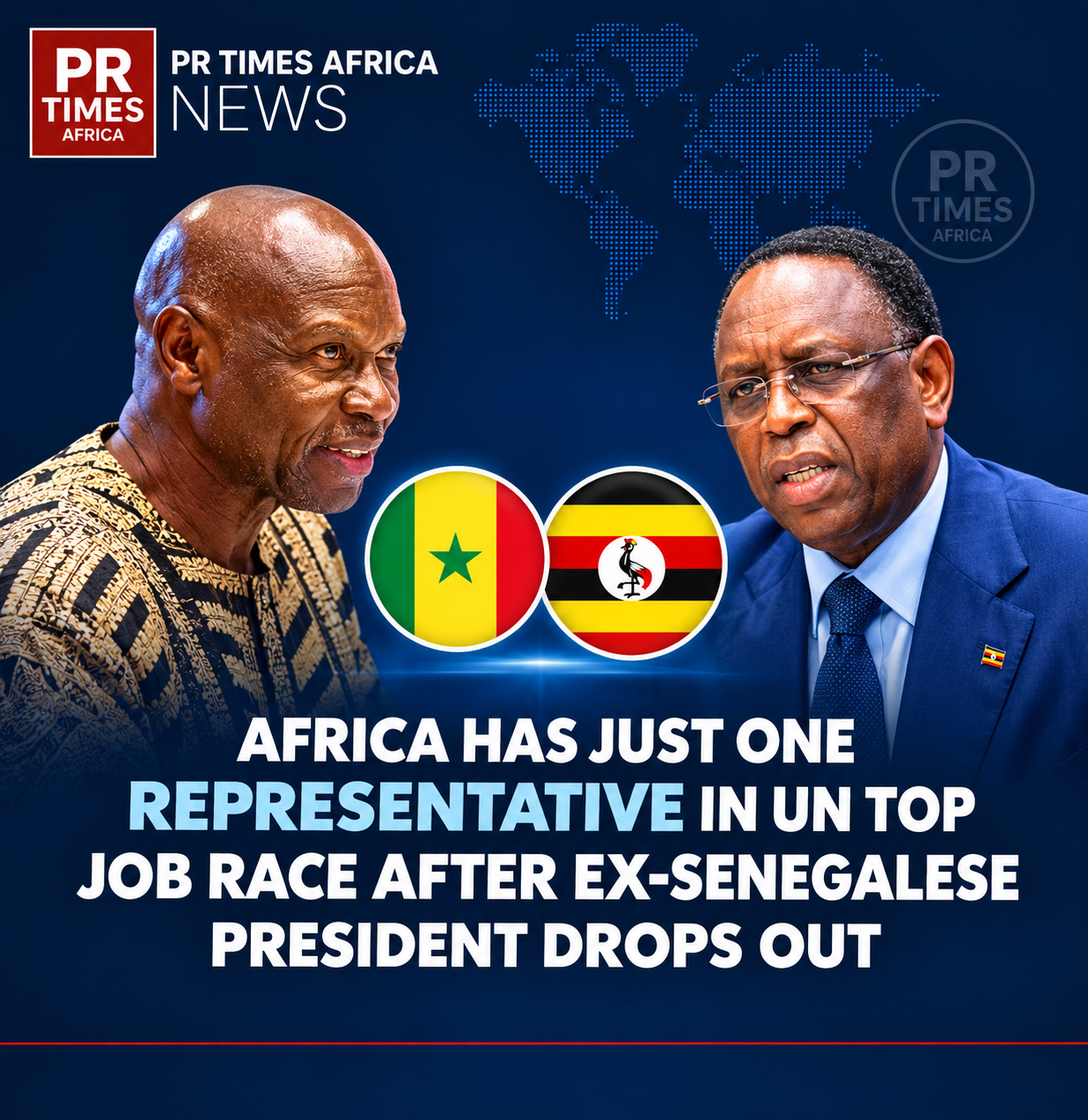
Why Macky Sall’s withdrawal exposes the communication and consensus-building challenges behind Africa’s
quest for global leadership
By Musa Sunusi Ahmad
When Ambition Meets Diplomacy
In international diplomacy, a compelling candidate is not always enough to secure the world’s most influential
diplomatic office. Behind every high-profile campaign lies a complex web of political alliances, institutional
endorsements, stakeholder interests and strategic communication. A candidate may possess the experience,
credentials and ambition required for global leadership, yet struggle to gain the consensus necessary to turn
that ambition into reality.
This challenge has come into sharp focus in the race for the next Secretary-General of the United Nations,
following the withdrawal of former Senegalese president Macky Sall from the contest on 17 October 2026. His
exit left Uganda’s Olara Otunnu as Africa’s sole remaining candidate in the field at that point.
For public relations practitioners, communication strategists, diplomats and public affairs professionals, the
development offers a case study in the relationship between political ambition, stakeholder alignment,
reputation management and international influence.
Sall’s withdrawal was more than a candidate’s departure from a competitive selection process. It raised
questions about how candidates build legitimacy, how governments coordinate their diplomatic objectives,
how regional institutions communicate collective positions, and how competing stakeholders influence the
public narrative surrounding a campaign.
At its heart, the episode highlights a fundamental principle of strategic communication: a strong message can
attract attention, but only credible relationships, institutional legitimacy and stakeholder confidence can
sustain influence.
The Candidate Is Only One Part of the Campaign
The position of UN Secretary-General is among the most prominent leadership roles in international affairs.
The office requires diplomatic skill, political judgement, institutional credibility and the ability to engage
countries with different interests and competing priorities.
Yet the selection process is not simply a global popularity contest.
Under the UN Charter, the Security Council recommends a candidate for appointment by the General
Assembly. The five permanent members of the Security Council have veto power over substantive decisions,
making their positions particularly consequential.
This means that a candidate’s qualifications and public profile, while important, must be accompanied by
sustained diplomatic engagement and a credible pathway to securing sufficient support among key decision
makers.
For communication professionals, this distinction is crucial. A campaign for an international leadership
position is not merely about projecting a persuasive personal brand. It is also about building confidence
among the institutions, governments and influential stakeholders whose support can determine the outcome.
The candidate must communicate competence, but the campaign must also demonstrate legitimacy. The
individual must inspire confidence, while the institutions supporting that individual must communicate
consistency and credibility.
When these elements are not aligned, even an ambitious campaign can encounter resistance.
Macky Sall’s Withdrawal and the Challenge of Consensus
Macky Sall’s candidacy attracted attention because of his experience as a former head of state and his
ambition to lead the United Nations. However, his campaign also faced questions about the process through
which his candidacy gained African support.
Burundi nominated Sall, but his candidacy was reportedly absent from the list of African candidates presented
to the African Union Executive Council at its February summit. His nomination subsequently became the
subject of a contested process involving African governments.
According to reports, Burundi circulated a draft decision to African Union and UN member states, giving them
a limited period to object. The initiative attracted opposition from several countries, including Nigeria, amid
concerns about procedure, the extent of continental consultation and the implications for Africa’s collective
position.
Senegal also distanced itself from the process, stating that it was not associated with Burundi’s initiative.
These developments exposed a significant challenge: the difference between securing a nomination and
establishing broad-based political legitimacy.
From a strategic communication perspective, this distinction matters because an endorsement is not merely a
formal declaration. It is a signal of confidence, alignment and shared purpose. Where the process behind an
endorsement is disputed, the endorsement itself may become a source of controversy rather than a
foundation for support.
A campaign may communicate a candidate’s strengths effectively and still struggle if influential stakeholders
question the legitimacy of the process through which the candidate emerged.
The lesson is that stakeholder confidence must be built before a campaign’s message can achieve its full
persuasive effect.
The African Union and the Problem of Speaking with One Voice
Africa’s pursuit of greater influence in global governance has long been accompanied by calls for stronger
continental coordination. The continent’s numerical representation in international institutions does not
automatically translate into unified political influence.
The UN Secretary-General race illustrates why.
For a candidate presented as a continental contender, support from individual African governments can be
valuable. However, a fragmented endorsement process may weaken the perception that the candidate
represents a broadly agreed regional ambition.
This is where institutional communication becomes essential.
Regional organisations such as the African Union must manage different national interests while
communicating shared priorities. Their effectiveness depends not only on formal decisions but also on the
credibility of consultation, clarity of procedures and confidence among member states.
When member states disagree over a candidate’s legitimacy or the process used to promote that candidacy,
the resulting controversy can overshadow the candidate’s qualifications.
The communication challenge is therefore twofold. First, stakeholders must negotiate their differences.
Second, they must communicate the resulting position in a manner that reflects genuine agreement rather
than an appearance of unity.
For the African Union, this underscores the importance of transparent consultation, clearly communicated
procedures and early engagement with member states before a high-profile international campaign is
launched.
A collective position is most persuasive when stakeholders understand how it was reached, believe their
interests were considered and have confidence in the institutions communicating it.
Without these foundations, calls for unity risk becoming messaging exercises rather than expressions of
genuine consensus.
Regional Rotation and the Politics of Expectations
The contest also unfolded against the background of an informal understanding that the next Secretary
General should come from Latin America and the Caribbean, a consideration that influenced perceptions of
the race.
Regional rotation is not a binding requirement of the UN Charter. Nevertheless, informal expectations can
shape diplomatic calculations, stakeholder positioning and the perceived viability of candidates.
For communication strategists, this illustrates the importance of understanding the environment in which a
campaign operates.
A candidate’s message does not exist in isolation. It competes with established expectations, regional
priorities, institutional traditions and the strategic calculations of governments.
An effective campaign must therefore identify the forces likely to shape decision-makers’ responses before
developing its public narrative.
This requires more than media monitoring. It calls for comprehensive stakeholder mapping: identifying who
holds influence, understanding what those stakeholders value, assessing the concerns that may prevent them
from offering support, and determining which arguments are likely to resonate with different audiences.
It also requires an ability to distinguish between obstacles that communication can address and those that
demand political negotiation.
A well-crafted narrative cannot, by itself, eliminate a regional preference or overcome a veto. But effective
communication can help a campaign explain its rationale, build relationships, address concerns and make
informed decisions about its prospects.
The Security Council Test: Where Messaging Meets Political Reality
The informal Security Council poll held on 16 October offered a further indication of the challenges facing
Africa’s remaining candidate.
Olara Otunnu received four “encourage” responses, ten “discourage” responses and one “no opinion”
response. These results were not a final decision, but they suggested that his campaign faced significant
obstacles.
For communication professionals, the distinction between visibility and viability is particularly relevant here.
A candidate can attract media coverage, deliver compelling speeches and generate public discussion without
securing the confidence of the people who ultimately determine the outcome.
This is a recurring challenge in public affairs and reputation management. Public sentiment, media attention
and institutional support are related, but they are not interchangeable.
A campaign that measures success mainly through press coverage, public statements or social media
engagement may overlook the more consequential work of building trust among decision-makers.
The appropriate response is not to dismiss public communication. Rather, it is to ensure that public messaging
supports a wider strategy involving private diplomacy, relationship management, credible evidence of
competence and a clear understanding of the decision-making process.
The most effective international campaigns recognise that different audiences require different forms of
engagement, while all communication must remain consistent with the campaign’s underlying objectives.
Reputation Management Begins Before the Crisis
Sall’s withdrawal also demonstrates why reputation management should begin long before a campaign
encounters a setback.
In high-stakes diplomacy, reputation is shaped by more than an individual’s record. It is influenced by the
conduct of allies, the credibility of endorsing institutions, the transparency of procedures and the consistency
of public explanations.
A candidate may have an established international profile, but questions about the process surrounding the
candidacy can create a separate reputational challenge.
Once doubts emerge, communication teams must do more than issue statements defending the candidate.
They must understand the source of the concerns, identify the stakeholders who hold them and determine
whether the concerns require clarification, negotiation or substantive changes to the campaign.
This is an important distinction between reputation management and publicity management.
Publicity management focuses on what audiences see and hear. Reputation management addresses the
reasons audiences trust, question or reject what they see and hear.
In Sall’s case, the wider debate involved not only his qualifications but also the political and institutional
process behind his candidacy. That distinction illustrates why a campaign’s credibility cannot be sustained
through personal branding alone.
For PR practitioners, the lesson is clear: reputation is built through the relationship between what an
organisation says, what it does and how stakeholders experience its conduct.
Where those elements are inconsistent, communication can explain the situation but may not be sufficient to
resolve it.
Withdrawal Is Also a Communication Decision
Sall announced his withdrawal following the informal Security Council poll and consultations with Burundi’s
president, Évariste Ndayishimiye, who was then chair of the African Union, and Senegal’s president, Bassirou
Diomaye Faye, who was then chair of ECOWAS.
He presented his decision in terms of building consensus within the Security Council.
The framing of a withdrawal matters. In a highly visible diplomatic contest, stepping aside can be interpreted
in different ways: as an admission that support is insufficient, a strategic decision to avoid prolonging a divisive
campaign, or an attempt to preserve relationships and redirect attention towards a broader objective.
A carefully managed exit can help protect a candidate’s long-term credibility. It can also reduce uncertainty for
supporters, provide clarity to stakeholders and create space for future diplomatic engagement.
However, the effectiveness of such communication depends on whether the explanation is credible and
consistent with the events stakeholders have observed.
Communication teams should therefore prepare for difficult scenarios from the beginning of a campaign. This
includes defining the circumstances under which a candidate might reconsider participation, identifying the
stakeholders who must be consulted and preparing a transparent approach to communicating major decisions.
A withdrawal strategy should not be improvised after adverse developments. It should form part of the wider
risk-management framework.
The objective is not to disguise an unfavourable outcome. It is to communicate a difficult decision accurately,
preserve institutional relationships where possible and demonstrate that the decision has been taken with an
understanding of the wider implications.
What This Means for PR and Communication Professionals
The developments surrounding Africa’s UN Secretary-General race offer several lessons for practitioners
working in government communication, public affairs, corporate reputation, international relations and
institutional leadership.
1. Stakeholder alignment must precede public positioning
Before announcing a major campaign, organisations should understand the interests and concerns of the
people whose support will be necessary. Early consultation can identify disagreements before they become
public controversies.
2. Endorsements must be credible, not merely visible
An endorsement has strategic value when stakeholders believe it reflects a legitimate decision.
Communication professionals should therefore pay attention to the process behind an endorsement, not
simply its prominence in public messaging.
3. Public relations cannot substitute for political consensus
Communication can explain a position, build understanding and create opportunities for engagement. It
cannot independently resolve every political disagreement. Effective strategies combine communication with
substantive consultation and negotiation.
4. International campaigns require audience-specific engagement
A public speech, a media interview, a diplomatic consultation and a formal institutional submission serve
different purposes. Campaigns should adapt their communication to each audience while maintaining a
coherent central position.
5. Reputation must be managed through conduct
Credibility depends on consistency between words and actions. Transparent processes, clear explanations and
respect for institutional procedures are essential components of reputation management.
6. Scenario planning should include the possibility of withdrawal
A campaign needs more than a winning narrative. It needs a plan for adverse poll results, declining support,
public criticism and strategic reassessment. Prepared communication can help decision-makers respond with
clarity rather than panic.
7. Continental unity must be demonstrated through process
For African institutions, a unified message is more persuasive when it emerges from meaningful consultation
and a credible decision-making process. Unity cannot be sustained through slogans alone.
Olara Otunnu and Africa’s Remaining Opportunity
With Sall’s withdrawal, Uganda’s Olara Otunnu remained Africa’s sole candidate in the field at the time of the
reported developments.
His position raises a broader question about Africa’s approach to international leadership contests: how can
the continent convert its aspirations for greater representation into a coordinated and credible diplomatic
strategy?
The answer extends beyond the fortunes of any individual candidate.
African governments and regional institutions need to consider how candidates are identified, how support is
negotiated, how competing national interests are managed and how a collective position is communicated to
international stakeholders.
This does not mean that African countries must always agree on a single candidate. Differences of opinion are
normal in international relations. The challenge is to establish legitimate processes for managing those
differences before they undermine a campaign’s credibility.
It also means preparing well in advance. Successful international campaigns require long-term relationship
building, a clear understanding of institutional procedures, consistent engagement with influential
stakeholders and realistic assessments of the political environment.
Communication should be integrated into this process from the beginning—not introduced only when a
campaign needs publicity or faces criticism.
For Africa, the opportunity is to develop a more systematic approach to international candidacies, one that
treats strategic communication as part of diplomatic planning rather than as a supporting activity.
The Limits of Communication: Strategy Must Be Matched by Substance
There is a danger in interpreting every diplomatic setback as a public relations failure.
Not every disagreement is caused by poor messaging, and not every unfavourable outcome can be corrected
by a better communication strategy. National interests, geopolitical competition, institutional rules and the
preferences of powerful states can constrain even the most carefully managed campaign.
The lesson from Sall’s withdrawal is therefore not that communication alone determines success. It is that
communication must be aligned with political realities, credible processes and sustained relationship
management.
A candidate needs a persuasive case, but the institutions supporting that candidate must also be able to
demonstrate legitimacy. A government needs a clear position, but it must also understand the concerns of
potential partners. A regional organisation needs a collective ambition, but it must establish the conditions
under which member states can genuinely support it.
Strategic communication is most effective when it connects these elements.
Influence Is Built Before the Spotlight
Macky Sall’s withdrawal from the UN Secretary-General race offers a timely reminder that international
leadership campaigns are as much about relationships and institutional credibility as they are about individual
qualifications.
For Africa, the episode highlights the continuing challenge of translating continental ambitions into
coordinated diplomatic influence. For PR and communication professionals, it demonstrates that reputation,
stakeholder engagement and strategic messaging must be integrated into decision-making from the outset.
The central lesson is not simply that a candidate needs better publicity or a stronger public narrative. It is that
credible communication depends on credible relationships, transparent processes and a realistic
understanding of how decisions are made.
In a contest shaped by national interests, regional expectations and the calculations of powerful states,
communication cannot guarantee victory. But when it i