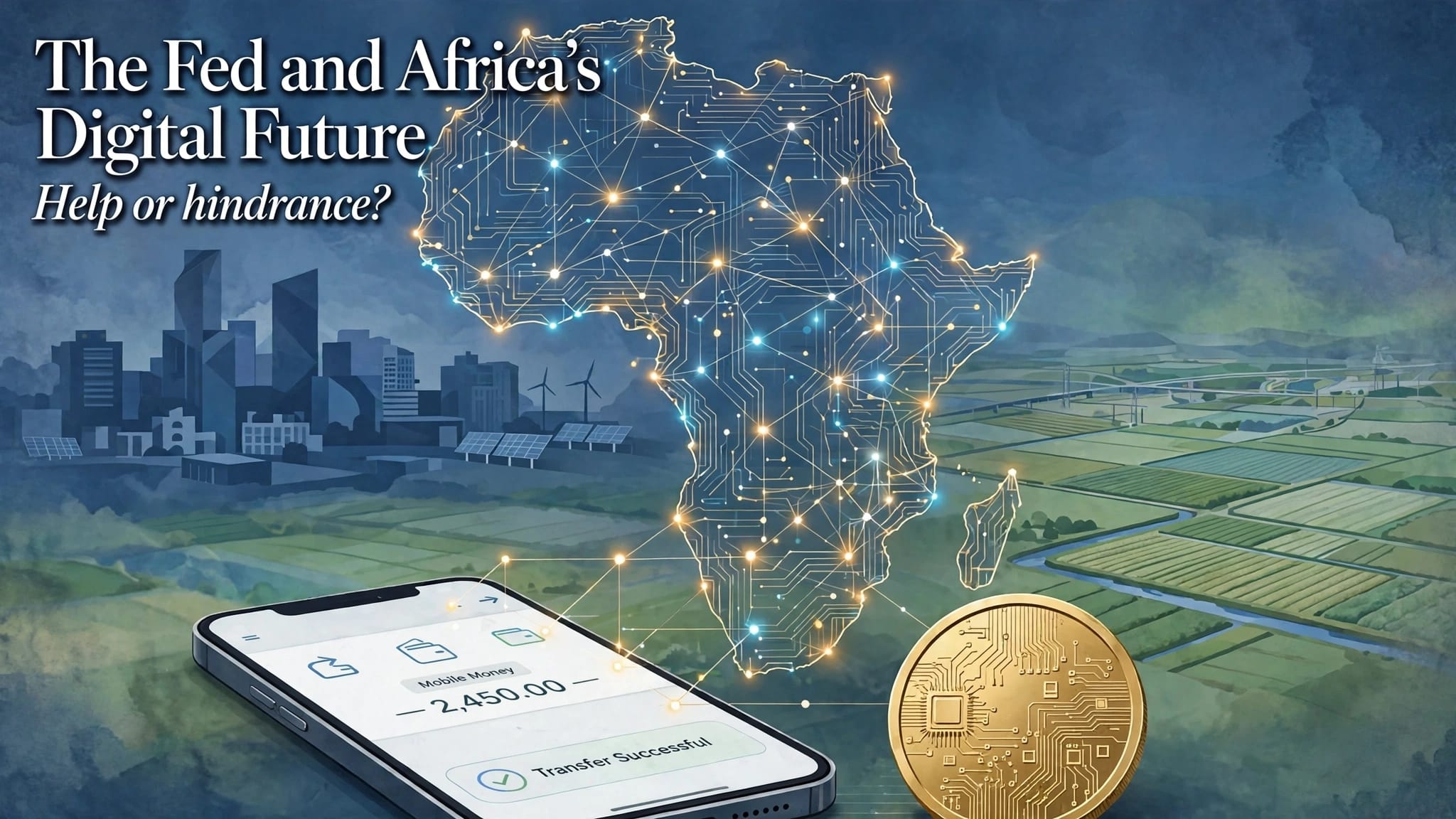
The Fed and Africa’s Digital Future
Help or hindrance?
A Concerned African Businessman.
Africa’s digital money revolution is gathering speed. From the person receiving money from a relative abroad to the business paying an overseas supplier, the benefits could reach almost every household. They could also reach the highest levels of banking, helping countries finance the projects their people need.
That is why the conduct of the Federal Reserve Bank of New York deserves scrutiny. Its public warning (see below) about EIG Global Trust (www.eigglobaltrust.com) is being challenged by people such as myself who believe EIG’s gold-backed digital currency could unlock substantial development finance for Ghana, and for Africa. Our concern is that an influential institution’s disputed statements could close doors to opportunities before African decision-makers have examined the evidence for themselves.
Fortunately, our information is that an EIGBC stablecoin lodgment has recently been accepted by a major African country, under a confidentiality agreement. This country is now positioned to begin using the collateral to support projects in excess of $40 Billion. This needs to be encouraged and provided to other African countries, but it appears the New York Fed, or possibly one of its member banks, is actively working to prevent this from succeeding.
What ordinary families stand to gain
Across Africa, many people already understand the convenience of mobile money. A payment can reach someone without a journey to a bank or a long wait in a queue. International digital payments promise to bring more of that convenience to money moving between countries.
Think of an African working abroad who sends money home for school fees. Every deduction leaves less for the family. Or consider a local trader paying a supplier in another country. A payment delay can hold up her stock while her customers buy elsewhere.
Cheaper transfers, quicker payments and clearer charges would make a real difference. Businesses could receive payments outside banking hours and spend less time waiting for their own money to become available.
Some of these services use stablecoins—digital currencies designed to maintain a value linked to an asset such as the US dollar or gold. People would still need to consider exchange rates and the cost of converting the tokens into money they can spend. Even so, the opportunity to improve on expensive, slow transfers is substantial.
For families already stretching a salary to cover food, transport, rent and school fees, lower costs are money left in the household budget.
Who benefits from keeping the old arrangements
A more transparent payment system would also reduce some opportunities for officials and intermediaries to seek unofficial payments. These demands may be presented as a small favour or a routine fee. To the person or company paying, they can be a serious burden, especially if they are legally prevented from participation in these “informal” payments, for example the Foreign Corrupt Practices Act in the US, but the 38 members of the Organization for Economic Cooperation and Development (OECD) also require all of its members to criminalize such practices, which are enabled, but certainly not encouraged, by the old, opaque, fiat based SWIFT system.
The wider question concerns those who influence Africa’s access to international finance. When new financial tools could reduce dependence on established channels, how do the institutions that oversee those channels respond?
The New York Fed has considerable influence in international banking. It could help African institutions understand and assess digital finance. That influence also means its warnings can carry enormous weight. A few words on its website may cause a bank to walk away before a proposal receives a proper hearing.
We should therefore examine how that power is exercised, who reviews the decisions and what happens when the accuracy of a warning is challenged.
Why EIG matters to this argument
EIG Global Trust’s proposal concerns something much larger than everyday money transfers. It presents its stablecoin, EIGBC, as an asset that central banks and commercial banks can use in arrangements supporting project finance.
Two terms explain the opportunity. Liquidity means money, or assets readily available to meet payments. Collateral means an asset pledged as security for a loan.
A manufacturer may have customers, a factory plan and capable managers, yet still be refused a loan because the bank wants more security. An acceptable collateral arrangement could help that business obtain finance, buy machinery and employ people.
The same principle can apply to larger projects: irrigation, food processing, transport and other infrastructure. The benefit to the public would come through productive businesses, employment and stronger local supply chains.
Our understanding of EIG’s model is that it makes collateral available and receives an equity stake or another agreed participation in projects financed through the arrangement. In plain language, it shares in the business created with its support.
EIG’s case rests on its stated gold and dollar backing, reserve audits and acceptance within relevant banking arrangements. Its supporters maintain that the supporting documentation can be examined by qualified officials as a clear, unequivocal Proof of Funds. They also report adoption in major economies, as noted above, including at least one large African nation. These are the foundations of the opportunity we believe African decision-makers should be able to investigate directly.
An African country should be able to examine the proposal on its merits, with access to the documents and institutions involved, such as the Bank for International Settlements.
The warning we are challenging
The New York Fed has published a warning about EIG and its stablecoins on its website. Among other things, it disputes representations concerning Federal Reserve backing, registration or auditing. https://www.newyorkfed.org/banking/frscams.html
We challenge the characterisation of EIG behind that warning. The existence of an official notice does not settle whether every statement in it is accurate, whether it fairly describes the proposed arrangements or whether subsequent evidence has received proper consideration.
This distinction is especially important because the warning itself is the subject of the complaint. Repeating it as the final answer avoids the very question being raised.
The Federal Reserve system includes a Board of Governors in Washington and regional Reserve Banks, including New York. Claims concerning any of these institutions should identify the particular institution and the action involved. The same precision should apply when those claims are disputed.
EIG’s supporters cite reserve documentation and banking standards in support of its collateral arrangements. The New York Fed should explain precisely which claims it rejects and why. Any disagreement about the documents should receive a direct, documented response.
Who is answering the questions
The complaint brought to us concerns a New York Fed representative responsible for relationships in sub-Saharan Africa. According to the complainant, calls and emails seeking a response have not resolved the matter, while the warning remains available to banks and the wider public.
If a statement can affect a country’s access to development finance, surely the people challenging it deserve an answer.
Who authorised the warning? What evidence supported it? What information has been submitted in response? Who has reviewed that information? What must happen for an inaccurate statement to be corrected?
A published institutional warning is the responsibility of the institution carrying it. Management should be able to explain the review process and account for the result. If it is a competitive act, this puts the impartiality of the New York Fed in serious jeopardy.
We also want to understand whether there are policy considerations influencing the treatment of such proposals. If there are, African governments and banks should know what those considerations are and how they are applied.
The people affected cannot be expected to accept silence while a disputed label continues to influence decisions about their future.
Africa cannot afford decisions made in the shadows
Many African countries have abundant resources but struggle to obtain the finance needed to process them at home. Raw materials leave; more valuable finished goods return. Meanwhile, young people complete their education and find too few jobs waiting for them.
A financing opportunity capable of helping change that pattern deserves serious examination. When an influential overseas institution discourages engagement, it should be prepared to explain its reasons fully and respond to evidence challenging its position.
This is why the dispute raises a broader concern about financial dependence. If African institutions feel unable even to examine a proposal because of an unanswered warning from abroad, how much freedom do they have to choose their own development path?
That is the basis of our concern about a continuing form of financial control. The issue deserves public scrutiny because the consequences extend beyond bankers’ offices to workers, business owners and families.
We are asking for accountability
The New York Fed should provide a substantive response to the challenge, explain the evidence behind its warning and correct any statements shown to be inaccurate. African central banks should have access to the information needed to reach their own conclusions.
The wider question remains: how will established financial institutions use their influence as Africa develops its digital financial capabilities? Will they help countries assess and use new opportunities, or put obstacles in their way without an adequate explanation?
Africa’s prosperity is at stake. Institutions whose statements can shape that prosperity must be willing to answer questions openly.
- Harnessing data and digital tools to strengthen social protection.
- Economic Community of West African States (ECOWAS) Commission holds technical meeting for the establishment of economic and social council in west Africa.
- Malawi Unveils Updated Pathogen Genomic Surveillance Strategy.
- CORRECTION: New Study Shows the Coca-Cola System has an Economic Impact of $10.4 Billion Across its Value Chain in Africa, Supporting More Than 1 Million Jobs
- Economic Community of West African States (ECOWAS) strengthens its strategy to make West Africa a world tourist destination of choice.
- Aline Varre: Bridging Capital, Creativity, and Change Across Africa