Day: June 18, 2026

  • South Africa Confronts Rising Anti-Migrant Tensions As Labor Unions Warn Of Economic And Social Risks

    South Africa Confronts Rising Anti-Migrant Tensions As Labor Unions Warn Of Economic And Social Risks

                                                                              South Africa Confronts Rising Anti-Migrant Tensions As Labor Unions Warn Of Economic And Social Risks

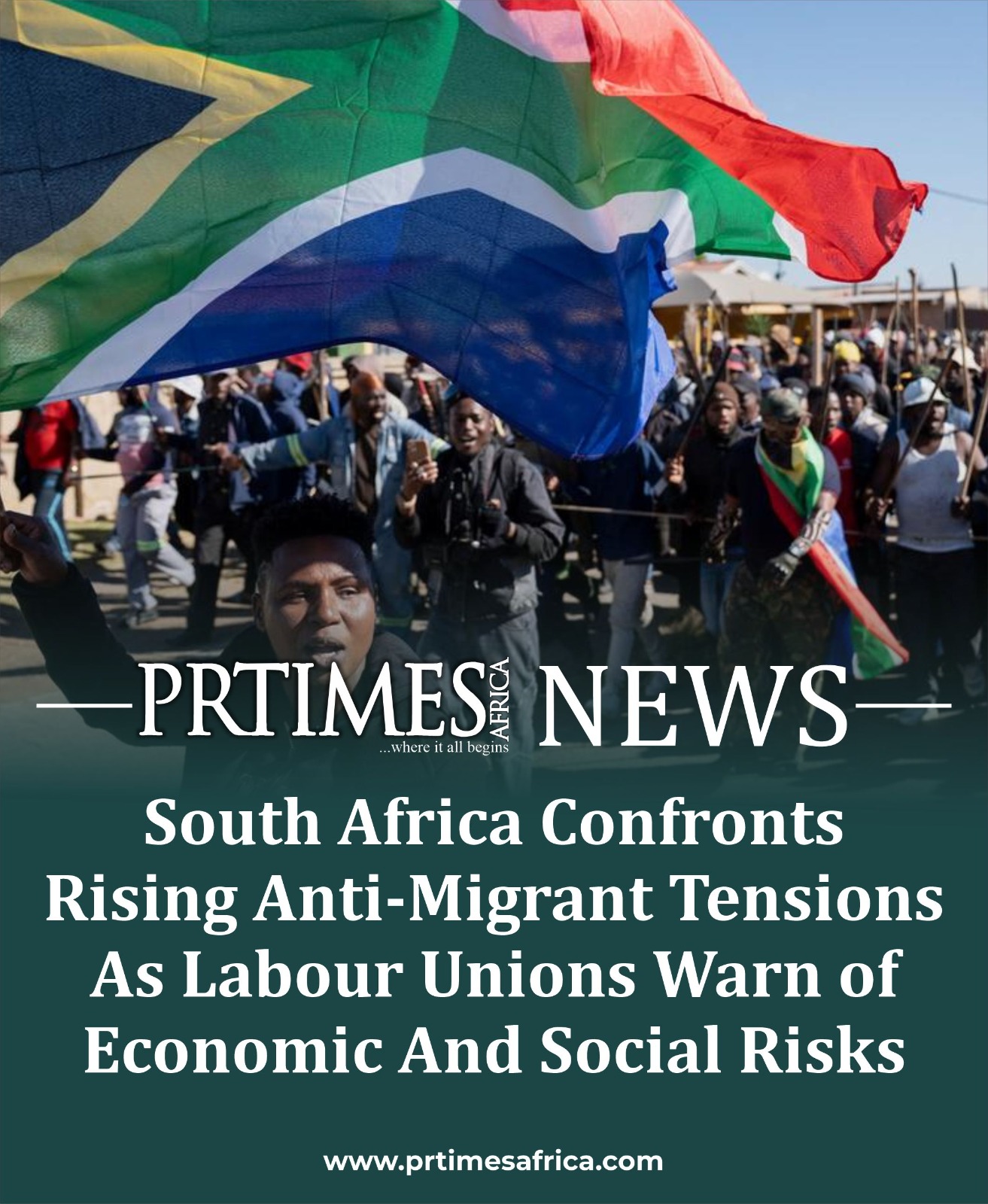
    JOHANNESBURG, South Africa — South Africa is facing renewed scrutiny over immigration and social cohesion as labor unions, civil society groups, and political leaders caution against a wave of planned anti-migrant protests that threaten to deepen divisions in Africa’s most industrialized economy.
    The growing tensions come amid persistent economic challenges, including high unemployment, rising living costs, and mounting pressure on public services. While some activist groups have blamed undocumented migration for worsening socio-economic conditions, labour organizations argue that targeting migrants risks distracting attention from deeper structural issues affecting the country’s economy.
    South African labour unions have publicly urged workers to distance themselves from demonstrations perceived as anti-foreigner campaigns, warning that such actions could fuel xenophobia, damage community relations, and undermine national stability. The call reflects increasing concerns over the potential for violence and social unrest in a country that has previously witnessed deadly outbreaks of xenophobic attacks.
    President Cyril Ramaphosa has also condemned the scapegoating of migrants, emphasizing that criminality and economic hardship should not be attributed to entire communities based on nationality. Government officials have reiterated their commitment to enforcing immigration laws while promoting social harmony and respect for human rights.
    The debate highlights a broader challenge confronting many nations across the continent and beyond: balancing border management, economic opportunity, and social integration in an era of increased migration. South Africa remains a major destination for migrants from neighboring countries, many of whom contribute significantly to sectors such as agriculture, mining, construction, retail, and informal trade.
    Economic analysts note that migration often plays a complex role in national development. While concerns over employment competition persist, numerous studies have shown that migrant workers frequently fill critical labour gaps, support entrepreneurship, and contribute to economic activity. The challenge for policymakers lies in developing effective migration frameworks that protect citizens’ interests without encouraging discrimination or exclusion.
    The developments are being closely monitored by regional leaders and international observers, particularly as the continent advances efforts toward greater economic integration through initiatives such as the African Continental Free Trade Area. Sustained social stability is widely regarded as essential to unlocking the full benefits of regional trade and investment.
    PR Times Africa Analysis
    South Africa’s immigration debate extends beyond national politics. It reflects a larger conversation taking place across Africa about economic inclusion, job creation, urbanization, and the movement of people within an increasingly interconnected continent. How South Africa navigates these tensions may offer important lessons for other African nations grappling with similar challenges.
    As policymakers seek solutions, experts argue that sustainable economic growth, skills development, and effective governance—not social division—will ultimately determine the continent’s ability to create prosperity for its growing population.
    By PR Times Africa International Desk
  •     Africa Mobilizes $910 Million To Strengthen Ebola Defenses As Regional Health Security Takes Center Stage

                                                                                             Africa Mobilizes $910 Million To Strengthen Ebola Defenses As Regional Health Security Takes Center Stage

    LAGOS, Nigeria — Africa has secured a major boost in its fight against Ebola after governments, development partners, and global health institutions pledged approximately $910 million to support containment and response efforts in the Democratic Republic of the Congo and Uganda. The commitment marks one of the continent’s most significant coordinated public health financing initiatives in recent years and underscores the growing recognition that health security is fundamental to economic resilience and sustainable development.
    The funding comes as health authorities intensify efforts to contain outbreaks linked to the Bundibugyo strain of the Ebola virus, a variant that presents unique challenges due to the limited availability of approved vaccines and treatments specifically designed for the strain. The resources are expected to strengthen disease surveillance, emergency response systems, laboratory capacity, healthcare infrastructure, border screening operations, and community engagement programs across affected regions.
    Public health experts say the latest commitment reflects lessons learned from previous Ebola outbreaks and the COVID-19 pandemic, both of which exposed vulnerabilities in healthcare systems while demonstrating the importance of rapid intervention and regional cooperation.
    The response is being coordinated by the Africa Centres for Disease Control and Prevention in partnership with the World Health Organization and national governments. Officials say the funding will support both immediate containment measures and long-term investments aimed at strengthening Africa’s capacity to detect and respond to future health emergencies.
    Beyond the public health dimension, the outbreak carries significant economic implications. Infectious disease outbreaks can disrupt trade, tourism, agriculture, supply chains, and cross-border commerce, particularly in regions where economic activity depends heavily on the movement of people and goods. For investors and policymakers, effective outbreak management is increasingly viewed as a critical component of economic stability.
    The funding pledge also highlights Africa’s growing determination to lead its own health security agenda. Rather than relying solely on external interventions, African institutions are playing a more prominent role in coordinating responses, mobilizing resources, and building resilient healthcare systems capable of addressing emerging threats.
    As implementation begins, attention will focus on how quickly resources are deployed, the effectiveness of response strategies, and the ability of governments to maintain public confidence through transparent communication and community engagement.
    PR Times Africa Analysis
    The Ebola response represents more than a health intervention ,it is a strategic investment in Africa’s future. In an increasingly interconnected world, disease outbreaks can rapidly evolve into economic crises. By prioritizing preparedness, surveillance, and regional cooperation, African leaders are signaling that health security is no longer a peripheral concern but a core pillar of economic growth, investment confidence, and national development.
    The success of this initiative could become a defining example of how Africa addresses complex cross-border challenges through collective leadership, institutional coordination, and long-term strategic planning.
    By PR Times Africa International Desk
  • Africa Leads Global Push Against Illegal Fishing As 15 Nations Sign Landmark Mombasa Declaration

    Africa Leads Global Push Against Illegal Fishing As 15 Nations Sign Landmark Mombasa Declaration


                                                                                    Africa Leads Global Push Against Illegal Fishing As 15 Nations Sign Landmark Mombasa Declaration

    MOMBASA, Kenya — In a significant step toward protecting marine resources and strengthening the blue economy, fifteen countries from Africa, Europe, Asia, the Caribbean, and the Pacific have adopted the Mombasa Declaration, a landmark agreement designed to combat Illegal, Unreported, and Unregulated (IUU) fishing.
    The declaration was endorsed during the 11th edition of the Our Ocean Conference in Mombasa, Kenya, marking the first time the global gathering has been hosted on African soil. The agreement is being hailed as a major victory for international cooperation in the fight against a practice that continues to undermine food security, economic growth, and environmental sustainability across the world’s oceans.
    Illegal fishing is estimated to cost the global economy tens of billions of dollars annually, with African coastal nations among the hardest hit. The practice deprives governments of vital revenue, threatens fish stocks, weakens legitimate businesses, and places millions of livelihoods at risk, particularly in communities where fishing remains a primary source of income.
    Under the Mombasa Declaration, participating countries have committed to improving transparency in fishing operations through enhanced vessel monitoring, greater disclosure of vessel ownership information, stronger licensing systems, and increased cooperation in sharing intelligence and enforcement data across borders.
    The signatories include several African nations alongside international partners, reflecting a growing consensus that combating illegal fishing requires coordinated action that extends beyond national jurisdictions.
    For Africa, the agreement carries particular significance. The continent possesses some of the world’s richest marine ecosystems and fisheries resources, yet many countries continue to lose substantial economic value due to weak enforcement capabilities and transnational fishing activities that operate outside legal frameworks.
    Experts argue that strengthening ocean governance is essential not only for environmental conservation but also for unlocking the full potential of Africa’s blue economy. Sectors such as fisheries, maritime transport, coastal tourism, and marine renewable energy are increasingly viewed as strategic drivers of future economic growth.
    The declaration also aligns with broader continental efforts to promote sustainable development, food security, and climate resilience. As populations continue to grow and demand for marine resources increases, effective management of ocean assets is becoming an increasingly important policy priority.
    PR Times Africa Analysis
    The Mombasa Declaration signals Africa’s emergence as a leading voice in global ocean governance. While illegal fishing has long been treated as an environmental challenge, policymakers are increasingly recognizing it as an economic and security issue with far-reaching to consequences.
    For investors, governments, and development institutions, the success of the declaration will ultimately be measured by implementation. Enhanced transparency, stronger enforcement mechanisms, and cross-border cooperation could significantly reduce revenue losses while helping to create a more sustainable and profitable fisheries sector.
    As Africa seeks to diversify its economies and expand opportunities within the blue economy, the protection of marine resources is no longer merely an environmental objective—it is a strategic economic imperative.
    By PR Times Africa International Desk

Hot daily news right into your inbox.

Headline

Never Miss A Story

Get our Weekly recap with the latest news, articles and resources.
Cookie policy
We use our own and third party cookies to allow us to understand how the site is used and to support our marketing campaigns.