PR TIMES AFRICA | INTERNATIONAL BUSINESS
DANGOTE TAKES AFRICAN ENERGY EXPANSION TO S OUTHERN AFRICA WITH $2.5 BILLION NAMIBIA PROJECT
Nigerian industrialist launches major fuel storage and pipeline investment, positioning Namibia as a strategic gateway for regional energy distribution.
WALVIS BAY, NAMIBIA | NOVEMBER 2026
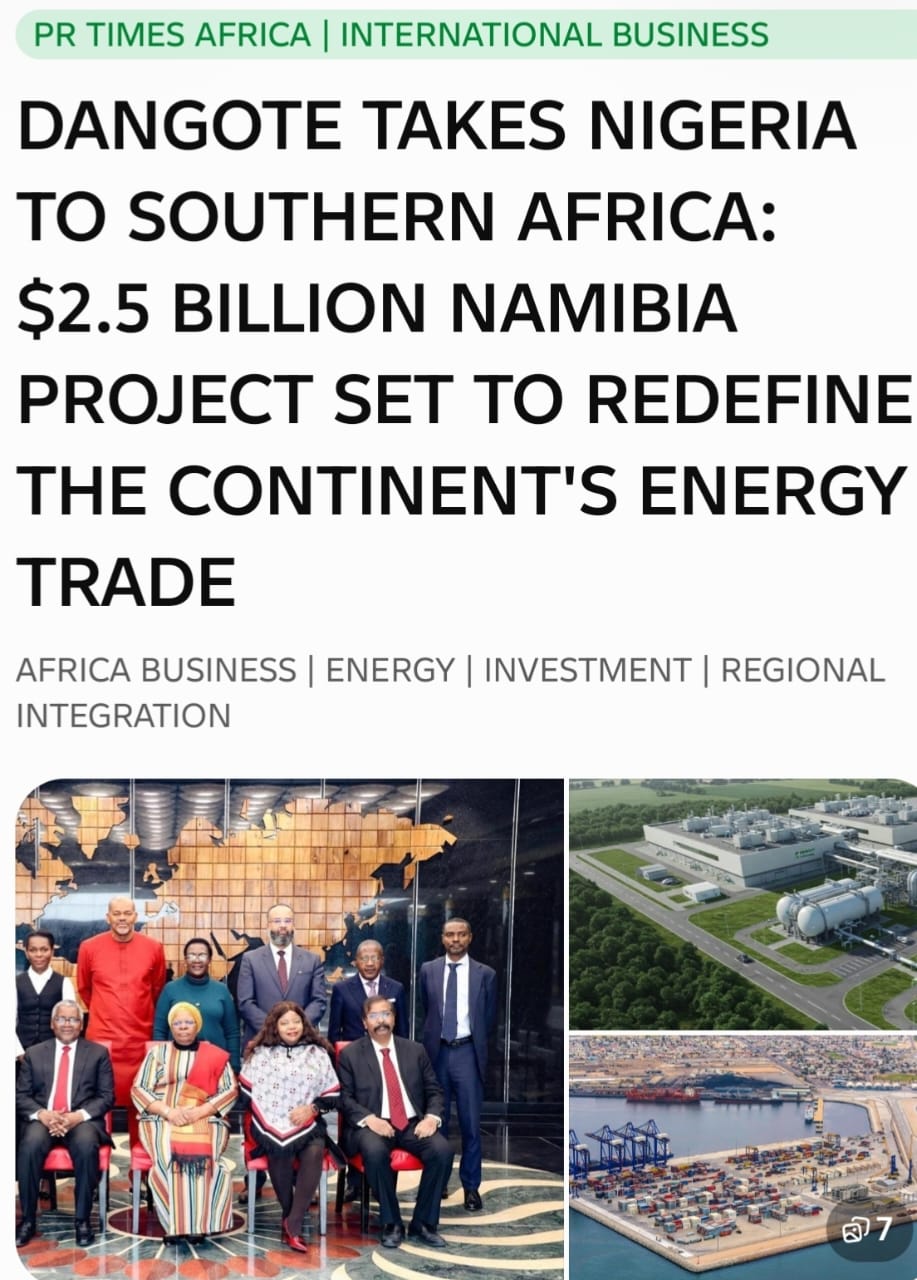
Africa’s energy and industrial landscape is entering another significant phase as Nigerian billionaire and industrialist Aliko Dangote expands his business ambitions into Southern Africa with a proposed $2.5 billion energy infrastructure investment in Namibia.
The project, officially launched in Walvis Bay on November 4, 2026, alongside Namibian President Netumbo Nandi-Ndaitwah, represents a major step in Dangote Group’s strategy to build an integrated petroleum storage and distribution network across African markets.
At the centre of the investment is a massive fuel storage facility with a planned capacity of approximately 600 million litres, equivalent to four million barrels. The facility is expected to accommodate 360 million litres of diesel and 240 million litres of petrol, alongside truck-loading facilities and supporting distribution infrastructure.
But the ambition extends far beyond storage.
The project includes plans for an extensive pipeline network, with a proposed regional corridor connecting Namibia to neighbouring markets, including Botswana, Zimbabwe and Zambia, with potential extensions towards the Democratic Republic of Congo.
When fully developed, the infrastructure could position Walvis Bay as an important regional hub for petroleum distribution, opening new commercial opportunities and improving the movement of refined petroleum products across Southern Africa.
BEYOND NIGERIA: BUILDING A CONTINENTAL ENERGY NETWORK
For Dangote, the Namibia investment reflects a broader strategy to move beyond refining and establish a stronger presence in the infrastructure that connects energy producers to consumers.
With the Dangote Petroleum Refinery in Lagos serving as a major source of refined petroleum products, the company is seeking to develop distribution channels capable of reaching markets beyond West Africa.
The Namibia project could therefore create an important commercial corridor for Nigerian-refined petroleum products into Southern Africa.
It also highlights the growing importance of regional infrastructure in addressing Africa’s energy distribution challenges, where transportation costs, inadequate storage capacity and fragmented supply networks have historically affected market efficiency.
A NEW CHAPTER FOR AFRICAN INDUSTRIAL PARTNERSHIP
The investment carries significance for both Nigeria and Namibia.
For Namibia, the development presents an opportunity to strengthen its petroleum storage capacity, attract major private-sector investment and potentially expand its role in regional energy logistics.
For Nigeria, it demonstrates how indigenous industrial capital and manufacturing capacity can support commercial expansion into other African economies.
More broadly, the development raises an important question about the future of African economic integration: can African companies build the infrastructure required to move African products efficiently across African borders?
Dangote’s latest investment provides a practical example of how that ambition could take shape.
THE BIGGER PICTURE
Africa’s industrial future will not be determined by production capacity alone. It will also depend on the pipelines, ports, storage facilities, transportation networks and commercial partnerships that connect markets.
With the Namibia project, Dangote Group is making a significant move towards that wider infrastructure ambition.
If successfully delivered, the investment could reshape petroleum distribution across parts of Southern Africa and strengthen the commercial links between two major African economies.
For Africa, the message is increasingly clear: the next phase of industrial growth may belong to those who build not only the factories, but also the infrastructure that connects the continent.
PR TIMES AFRICA | Reporting on Business, Leadership, Investment and Africa’s Global Influence.