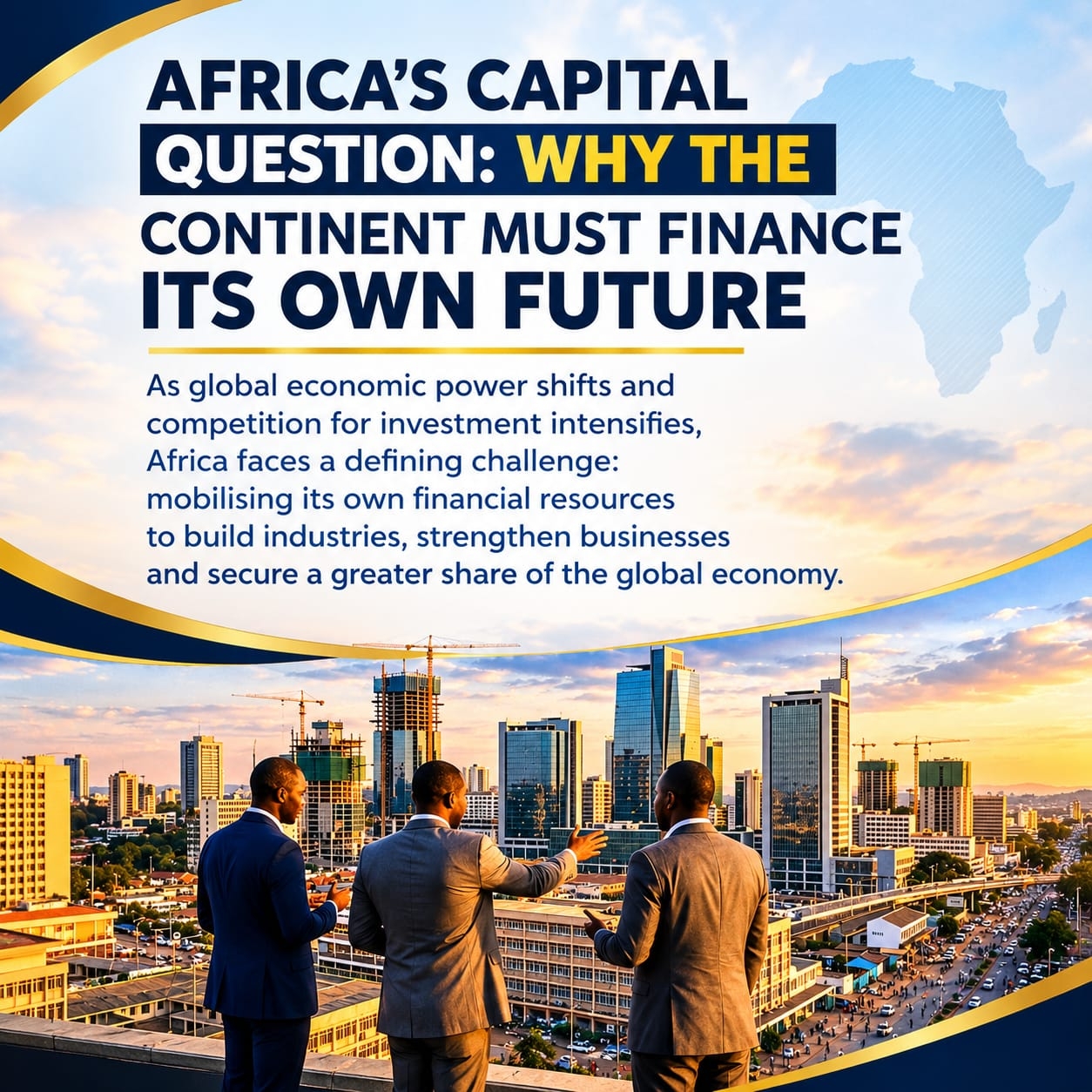
 AFRICA’S CAPITAL QUESTION: WHY THE CONTINENT MUST FINANCE ITS OWN FUTURE
As global economic power shifts and competition for investment intensifies, Africa faces a defining challenge: mobilising its own financial resources to build industries, strengthen businesses and secure a greater share of the global economy.
THE BUSINESS STORY
Africa’s economic future may depend less on how much foreign investment it attracts and more on how effectively it mobilises the wealth and financial resources already within its borders.
That is the central message emerging from a renewed debate about the continent’s place in an increasingly competitive global economy.
On November 10, 2026, former President of the African Export-Import Bank (Afreximbank), Professor Benedict Oramah, challenged African governments to reduce their dependence on foreign capital and currencies, arguing that domestic savings, stronger indigenous financial institutions and local currency financing are essential to long-term economic competitiveness.
Speaking at the 20th AELEX Yearly Lecture in Lagos, Oramah warned that geopolitical tensions, de-globalisation and rising protectionism are reshaping international trade and investment, leaving countries that depend heavily on external financing particularly vulnerable.
His message raises an important question: can Africa finance its own transformation?
THE FOREIGN CAPITAL DILEMMA
For decades, foreign direct investment has played an important role in financing African infrastructure, energy, telecommunications and extractive industries.
However, attracting investment is only one part of the economic equation. The bigger challenge is ensuring that the value generated by those investments translates into stronger local industries, employment, technology transfer and sustainable economic growth.
According to UN Trade and Development (UNCTAD), Africa attracted approximately $70 billion in foreign direct investment in 2025, compared with $94 billion in 2024. Despite the decline, the 2025 figure represented the continent’s third-highest investment level since 1990.
The figures demonstrate that international investors continue to recognise Africa’s strategic importance, particularly in energy, infrastructure and critical minerals.
But investment figures alone do not tell the whole story. The ability to retain economic value, develop local industries and finance long-term projects remains equally important.
THE OPPORTUNITY WITHIN AFRICA
Africa possesses significant financial resources, including pension funds, sovereign investment vehicles, domestic savings, institutional capital and a growing private sector.
The challenge is converting these resources into productive investments.
Oramah pointed to Afreximbank’s experience mobilising more than $40 billion through its central bank deposit programme during his tenure as evidence of what African financial resources can achieve when strategically organised.
This presents an important opportunity for African governments and financial institutions to rethink how development is financed.
Rather than depending almost exclusively on external borrowing and foreign currency financing, African economies can strengthen domestic capital markets, deepen regional financial cooperation and create more accessible financing structures for local businesses.
BEYOND RAW MATERIALS: THE INDUSTRIALISATION IMPERATIVE
Africa’s position in the global economy will also depend on its ability to move beyond exporting raw materials.
The global transition towards clean energy, electric mobility, advanced manufacturing and artificial intelligence is increasing demand for critical minerals and digital infrastructure.
For Africa, this presents an opportunity to move up the value chain.
Countries endowed with lithium, cobalt, copper and other strategic minerals must look beyond extraction and prioritise processing, manufacturing, technology development and industrial partnerships.
Similarly, investments in energy infrastructure and data centres will determine how effectively African economies participate in the expanding digital economy.
The objective should not simply be to supply the world’s resources, but to develop the industries, expertise and businesses capable of creating greater value from them.
THE GLOBAL COMPETITIVENESS TEST
Africa does not need to reject foreign investment. It needs to negotiate from a position of stronger economic capacity.
International partnerships remain important, but they must advance clearly defined national and regional development priorities.
This requires credible institutions, predictable policies, stronger infrastructure, deeper capital markets and a business environment that rewards long-term investment.
The African Continental Free Trade Area also offers an opportunity to expand regional markets, encourage cross-border investment and build businesses capable of competing beyond national boundaries.
Ultimately, Africa’s economic transformation will require a partnership between domestic capital, international investment, public institutions and private enterprise.
THE ROAD AHEAD
The question confronting African leaders is no longer simply how to attract more investors.
It is how to build economies capable of financing their own ambitions, developing their own industries and negotiating more effectively in the global marketplace.
Africa has the resources, the market potential and the entrepreneurial energy.
What remains is the strategic capacity to turn those advantages into lasting economic power.
The next chapter of Africa’s economic story must not be written solely by those who finance the continent. It must also be shaped by those who own, build and invest in its future.
PR TIMES AFRICA — Spotlighting the people, ideas and businesses shaping Africa and the world.