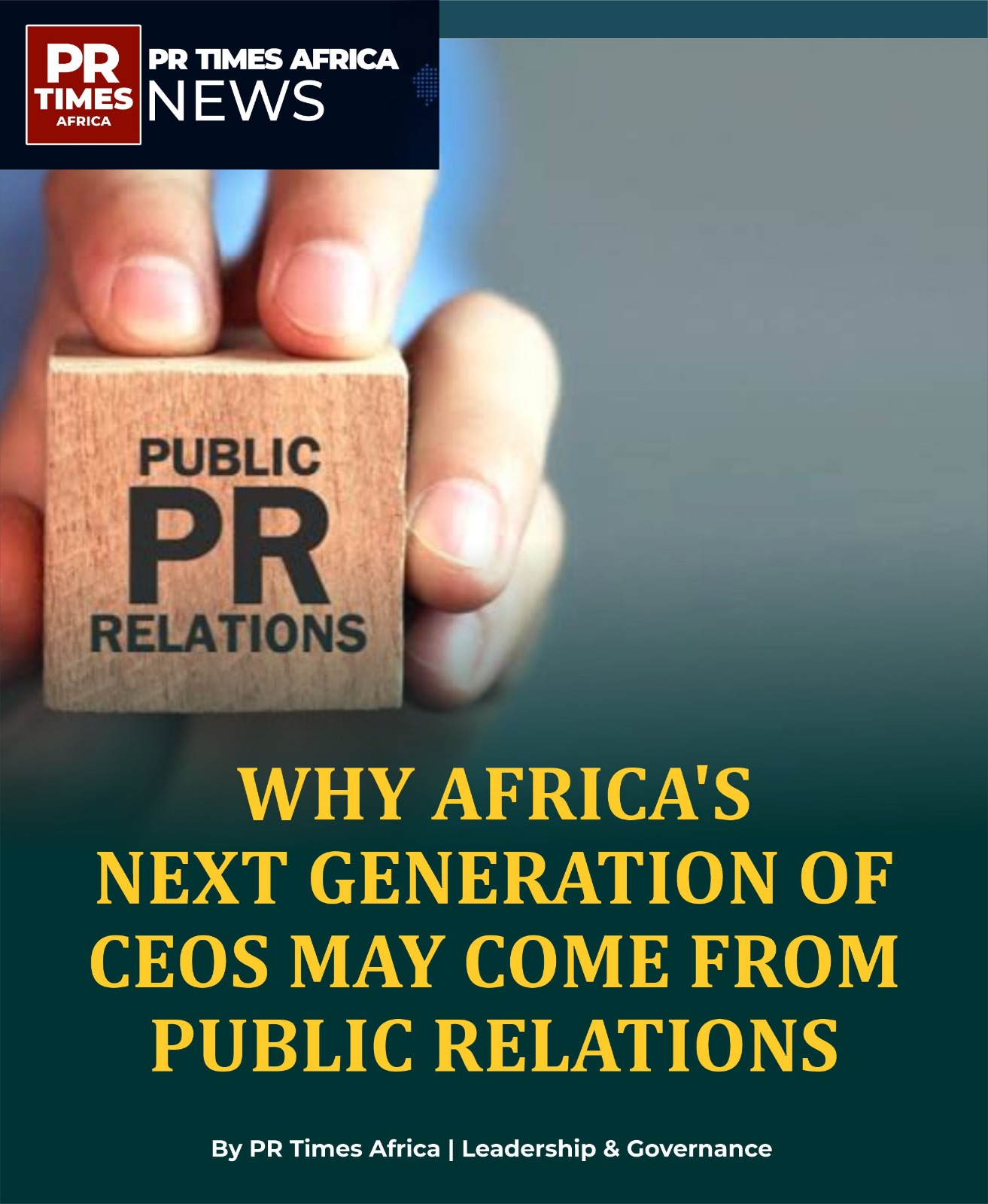

In an era defined by reputation, stakeholder trust and constant public scrutiny, Africa’s future corporate leaders may increasingly emerge from an unlikelybut strategically powerfulplace: public relations.
By PR Times Africa
For decades, the traditional route to the chief executive’s office was relatively predictable. The finance director became the CEO. The operations chief took charge. The entrepreneur who founded the company remained at the helm.
But the nature of leadership is changingand Africa may be at the centre of that transformation.
Tomorrow’s chief executives will be expected to do far more than manage balance sheets, increase market share and oversee operations. They will need to build trust across diverse stakeholders, navigate public scrutiny, communicate through crises, inspire employees, engage governments and communities, and protect the reputation of organisations operating in an increasingly transparent world.
Those are no longer peripheral leadership skills.
They are CEO skills, and that is why some of Africa’s next generation of influential business leaders may come from public relations.The CEO Has Become the Chief Storyteller, the modern CEO is no longer protected behind the walls of the boardroom.
Every major decision can become a public conversation. A customer complaint can escalate within hours. An employee’s experience can shape an employer’s reputation. A poorly handled statement can trigger a crisis, while an authentic message from leadership can strengthen trust.
In this environment, CEOs are increasingly required to serve as the organisation’s most visible communicators.
They must explain difficult decisions, communicate a vision, manage expectations and give employees, investors, regulators, customers and communities a reason to believe in the organisation.
This is where the strategic value of public relations becomes impossible to ignore.
Public relations professionals are trained to understand audiences, anticipate perceptions and manage relationships across complex environments. At their best, they understand that communication is not simply about publicityit is about influence, trust, reputation and relationships.
Those capabilities are becoming central to leadership.
Africa’s CEOs Must Manage More Than Business
The African business environment presents an especially complex leadership challenge.
A CEO may need to engage government institutions, regulators, investors, traditional leaders, host communities, employees, international partners and the mediaall while operating in markets shaped by rapid economic and social change.
A business can have an excellent product and still struggle if it loses public trust. An investment can face resistance if communities feel excluded. A government policy can affect an entire industry overnight. A reputational crisis can undermine years of corporate progress.
The ability to understand stakeholders is therefore becoming a strategic advantage.
Tomorrow’s African CEO will need to ask questions that extend beyond profit:
Who are we accountable to? Who is affected by our decisions? Who is not being heard? What risks are emerging? And what story are our actions telling?
These are questions that sit at the heart of strategic public relations.
From Reputation Management to Enterprise Leadership
For too long, public relations has been misunderstood as a function focused primarily on media coverage, press releases and events.
That definition is now too narrow.
Modern PR sits at the intersection of corporate strategy and public perception. It provides insight into stakeholder expectations and helps organisations understand how decisions may be received beyond the executive boardroom.
That perspective can make PR professionals particularly valuable in senior leadership.
A strong communicator understands that perception can influence commercial outcomes. A strong PR strategist understands that reputation is built over time but can be damaged quickly. And an experienced public relations leader understands that every stakeholder relationship has the potential to create either value or risk.
These are not merely communications insights.
They are business insights.
As African companies expand across borders and compete for capital, talent and consumer confidence, the leaders who can successfully align corporate ambition with stakeholder trust may hold a significant advantage.
Crisis Leadership Is Becoming a Core CEO Competency
Every CEO will eventually face a difficult moment.
A product failure. A labour disputes. A regulatory challenge. A social media controversy. A community conflicts. An economic shock.
In such moments, operational expertise alone may not be enough.
Leaders must know when to speak, what to say, who to engage and, sometimes, when to listen. They must communicate under pressure without appearing defensive, disconnected or insensitive.
Public relations professionals spend their careers working in this space.
They understand that a crisis is rarely managed by messaging alone. It requires judgement, preparation, stakeholder engagement and a clear understanding of public sentiment.
The CEO of the future will increasingly need these same capabilities.
The Rise of the Relationship Economy
Africa’s growth story is increasingly being shaped by relationships.
Business success depends not only on financial capital but also on social capital: trust between companies and communities, confidence between investors and management, and credibility between institutions and the public.
The organisations that succeed will be those capable of maintaining these relationships through periods of growth as well as uncertainty.
This is where public relations bring a different perspective to the executive table.
PR professionals are trained to look outward. They listen to the environment. They study sentiment. They understand competing interests and recognise that an organisation does not operate in isolation.
That external perspective can help future CEOs avoid one of leadership’s greatest dangers: becoming disconnected from the people whose trust determines long-term success.
The Future CEO Must Lead with Both Intelligence and Influence
The next generation of African CEOs will undoubtedly need financial literacy, technological understanding and operational discipline.
But they will also need influence.
They must be able to bring people together around a vision, communicate across cultures and create confidence during periods of uncertainty. They will need to understand how leadership decisions travel through media, communities and digital networks.
In other words, the successful CEO of tomorrow may need to combine the discipline of a business strategist with the instincts of a communicator.
That does not mean every public relations professional is automatically prepared to become a CEO.
Business leadership requires commercial expertise, financial competence, operational understanding and the ability to make difficult decisions.
But it does mean that organisations should stop viewing public relations as a department that enters the conversation only after decisions have been made.
Some of the leaders best positioned to lead complex organisations may already be sitting closer to the centre of stakeholder intelligence than companies realise.
A New Leadership Pipeline for Africa
Africa has an opportunity to redefine what the pathway to the CEO’s office looks like.
Rather than relying exclusively on traditional routes through finance, operations or sales, organisations can develop leadership pipelines that recognise strategic communication as a core executive capability.
Public relations professionals who build strong commercial and operational experience could become some of the most effective enterprise leaders of the next decade.
- They understand people.
- They understand perception.
- They understand crises.
- They understand reputation.
- And increasingly, they understand that business success is inseparable from public trust.
The Bottom Line
The question is not whether tomorrow’s CEOs will need to be better communicators.
They will.
The more important question is whether today’s boards and organisations will recognise communication and stakeholder leadership as serious pathways to the highest levels of executive responsibility.
Africa’s next great CEO may not come from the finance department, they may not come from operations, they may come from public relationsbringing with them an understanding that could define the future of leadership:
That in a world where trust is currency, relationships are capital and reputation can shape the future of a business, communication is no longer a support function. It is leadership.
And that may be why some of tomorrow’s most successful African CEOs are being shaped in public relations today.